-
 Vatican engaging pilgrims via social media for John Paul II's sainting2 April 2014
 -
Pope hits 1 million followers as he posts his first tweet12 December 2012
-
Pope gets more than half million Twitter followers5 December 2012
-
Vatican discloses Pope's Twitter handle: @pontifex3 December 2012
-
Pope Benedict XVI to get a 'personal' Twitter account10 November 2012
- Home
- Social networking
- Social networking News
- Pope turns to Twitter, new allies to battle for faith issues
Pope turns to Twitter, new allies to battle for faith issues
By Agence France-Presse | Updated: 28 December 2012 17:29 IST
Advertisement
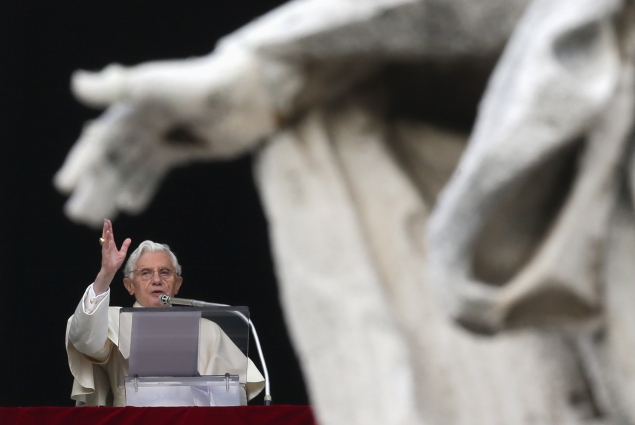
Pope Benedict XVI has galvanised Catholics at the close of 2012 to go on the offensive over key faith issues, forging new alliances and fighting secularism in the West with a media campaign.
Damaging sex abuse scandals and growing opposition to the Church's attitude toward gay marriage and women priests have forced Benedict to rethink how to communicate with the modern world and stem the flood of deserting believers.
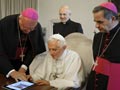
The 85-year-old pope joined Twitter this month as part of efforts to disseminate the Catholic message worldwide, which also forced the professorial pontiff to reduce his usual reams of dense theological reflections to 140 characters.
The Vatican in June hired American Fox News correspondent Greg Burke to help modernise its communications strategy and by December Benedict had sent his first tweet which went out in eight languages to thousands of followers.
The pope's tweets of faith may have sparked derision among some Twitter users, but they brought the Vatican widespread visibility among the digital generation, which was told that God is not dead but "knocking at the door."
The leader of the world's one billion Roman Catholics also took the unusual step of writing an editorial for Britain's Financial Times newspaper, urging business and political leaders to adhere to Christian ethics and moral codes in their daily lives.
Benedict's call to take a stand against what he views as society's ills -- such as consumerism and a wilful disregard of "traditional" family values - was repeated in his strongly-worded Christmas message which slammed the selfishness of modernity.
"We want ourselves. We want what we can seize hold of, we want happiness that is within our reach. We are so 'full' of ourselves that there is no room left for God. And that means there is no room for others either," he said.
The pope also began in earnest to follow through with one of the key ideas of his papacy, calling for dialogue with atheists, agnostics and others outside the Catholic Church who are nonetheless fighting the same battles.
In a bid against gay marriage which is gaining ground in the West, he took the first steps in finding new allies.
With France, Britain and the United States soon expected to join a dozen countries where same-sex couples can legally wed, Benedict reached out to religious and non-religious people alike who respect what he called the "law of nature".
Weighing into the heated debate, the pope cited France's chief Rabbi Gilles Bernheim, who has spoken out against gay marriage.
Benedict has also mobilised top Catholic figures to beat the drum on the Church's teachings on social issues, from the family to homosexuality and abortion.
The Vatican's new guardian of dogma, Germany's Gerhard Muller, Milan's Archbishop Angelo Scola, and Cardinal Gianfranco Ravasi, the pope's culture minister who is a keen Tweeter, are among those who have gone on the offensive.
"A small but influential group of bishops has formed around Benedict XVI and pays a great deal of attention to addressing the central questions of culture and society with weighty words," Vatican expert Sandro Magister told AFP.
Comments
For the latest tech news and reviews, follow Gadgets 360 on X, Facebook, WhatsApp, Threads and Google News. For the latest videos on gadgets and tech, subscribe to our YouTube channel. If you want to know everything about top influencers, follow our in-house Who'sThat360 on Instagram and YouTube.
Further reading:
Pope Benedict, Pope Benedict XVI, Twitter, Vatican, microblogging, social media, social networking
Related Stories

Advertisement

Follow Us

-

01:18
Gadgets 360 With Technical Guruji: Did You Know This About the Firefox Logo? -
02:23
Gadgets 360 With Technical Guruji: Hands on With the Samsung Galaxy Book5 Pro 360 -
02:23
Gadgets 360 With Technical Guruji: A Quick Look at the Google Pixel 9a -
01:31
Gadgets 360 With Technical Guruji: Scanning Documents Without Third-Party Apps -
02:40
Gadgets 360 With Technical Guruji: News of the Week [March 29, 2025]
Advertisement
Popular on Gadgets
- Samsung Galaxy Unpacked 2025
- ChatGPT
- Redmi Note 14 Pro+
- iPhone 16
- Apple Vision Pro
- Oneplus 12
- OnePlus Nord CE 3 Lite 5G
- iPhone 13
- Xiaomi 14 Pro
- Oppo Find N3
- Tecno Spark Go (2023)
- Realme V30
- Best Phones Under 25000
- Samsung Galaxy S24 Series
- Cryptocurrency
- iQoo 12
- Samsung Galaxy S24 Ultra
- Giottus
- Samsung Galaxy Z Flip 5
- Apple 'Scary Fast'
- Housefull 5
- GoPro Hero 12 Black Review
- Invincible Season 2
- JioGlass
- HD Ready TV
- Laptop Under 50000
- Smartwatch Under 10000
- Latest Mobile Phones
- Compare Phones
Latest Gadgets
- Lava Bold 5G
- Huawei Pura X
- Motorola Edge 60 Fusion
- Redmi A5
- Vivo Y300t
- Vivo Y300 Pro+
- Vivo Y300i
- Realme 14 5G
- Acer TravelLite (2025)
- Asus Zenbook 14 (2025)
- Samsung Galaxy Tab S10 FE+
- Samsung Galaxy Tab S10 FE
- Garmin Vivoactive 6
- Oppo Watch X2
- Haier M80F Mini LED 4K
- Haier M95E
- Nintendo Switch 2
- Sony PlayStation 5 Pro
- LG 1.5 Ton 5 Star Inverter Window AC (UW-Q18WUZA)
- LG 1.5 Ton 3 Star Inverter Split AC (US-Q18JNXE)

- About Us
- Sitemaps
- Feedback
- Archives
- Contact Us
- RSS
- Advertise
- Career
- Privacy Policy
- Ethics
- Editorial Policy
- Terms & Conditions
- Complaint Redressal
Download Our Apps
Available in Hindi
© Copyright Red Pixels Ventures Limited 2025. All rights reserved.