-
 Threads App Sees Over 50 Million Users Sign Up Within a Day as Instagram's Competition With Twitter Heats Up7 July 2023
 -
Zoom Joins Meta, Microsoft as the Newest Member of Tech Industry Counterterrorism Group GIFCT16 December 2021
-
Best Movies on Netflix in India [September 2021]9 September 2021
-
Twitter May Launch New Features to Simplify Direct Messages, Retweets8 October 2020
-
The Social Network 2: Aaron Sorkin Will Write if David Fincher Returns8 October 2020

- Home
- Social networking
- Social networking News
- Facebook users hit 'like,' stores jump into action
Facebook users hit 'like,' stores jump into action
By Associated Press | Updated: 19 December 2012 14:32 IST
Advertisement
Facebook isn't just for goofy pictures and silly chatter. Whether shoppers know it or not, their actions online help dictate what's in stores during this holiday season.
After polling customers on the social media site, Macy's decided to carry denim jeans in bright neon hues rather than pastels. Wal-Mart for the first time decided to let customers vote on which toys they want discounted. And to better plan orders for the decorative flags she sells, a small business owner in Mississippi is running a contest that encourages customers to chime in about how they're decorating their homes this winter.
The impact of social media on a company's bottom line is tough to quantify, with no hard data on how millions of Facebook fans and Twitter followers translate into sales for stores. But during the holiday shopping season, a roughly two-month period when retailers can make up to 40 percent of their annual revenue, stores are uncovering a valuable use for all the seemingly useless online muttering: market research.
The result is that whenever folks press the "like" button to give their seal of approval for a particular company's page or make a comment on how much they like the leather boots they just bought, they're helping everyone from independently-owned small shops to the nation's biggest retailers make decisions about what products to stock up on, what to play up on the sales floor and what promotions to offer online.
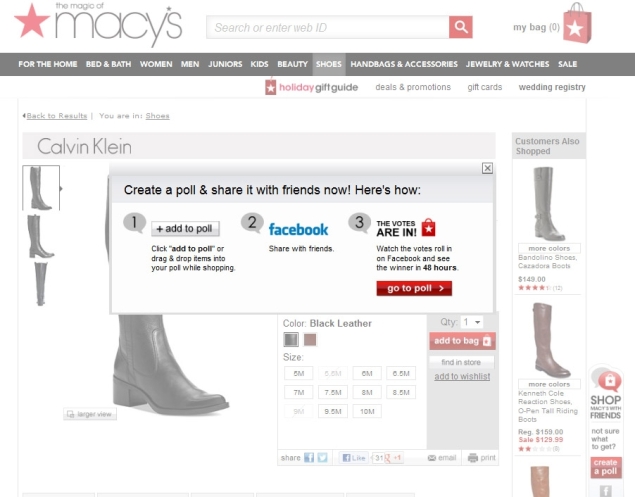
For the first time this year, one of Macy's Inc.'s apparel buyers suggested the company solicit feedback on Facebook on which colors it should stock for "Else" brand jeans in the fall ahead of the holiday shopping season. Several weeks later, with about 2,500 "likes" and 750 comments, "Very Vivid" colors in bright blue, orange and red were declared the victor over softer shades such as baby pink and baby blue.
The company, which has more than 9 million "likes" on Facebook, followed up with another poll in July on whether it should carry a "Kensie" brand dress in a bird or floral print. About 4,000 people issued their verdicts within 48 hours, and the department store plans to carry the floral print this February.
Rather than simply using social media to tout promotions and new products, companies are just now realizing the value of making customers feel as though they're part of the decision making process, said Jennifer Kasper, who heads digital media at Macy's. In addition to making customers feel like insiders, she said it helps businesses better tailor their offers as well.
Matt Cronin, a founding partner of Web Liquid Group, a digital marketing agency, agreed that companies are still in the early stages of figuring out how to put their social media profiles to use. Until now, he noted that social media strategies have primarily been about capturing as many followers or fans as possible without really knowing where to go from there.
One hurdle for major retailers is that it's difficult to take the information they learn online and put it to use while the trends are still relevant, said Nicolas Franchet, head of retail e-commerce at Facebook.
That's one of the trickier aspects of Wal-Mart Store Inc.'s new "Toyland Tuesday" contest, which lets fans vote on which of two toys will be discounted on the following Tuesday. Once a winner is declared on Thursday, the retailer acts quickly to inform its 4,000 stores of how to adjust pricing and displays, says Wanda Young, senior director of social media for Wal-Mart, which has more than 25 million likes on Facebook.
Although it's the first time Wal-Mart is letting shoppers have a direct say in what merchandise gets discounted, the retailer is learning to use social media in more discreet ways as well. Last year, Wal-Mart, based in Bentonville, Ark., acquired an analytics company called Kosmix that monitors online chatter to try and predict what products might suddenly become popular.
The unit, now called (at)Walmartlabs, suggested that the retailer give juicers prominent display for the holidays last year, after a movie about an obese man who lost weight on a juice diet started trending online. Wal-Mart declined to give examples of how it used online chatter this holiday season but said it's slowly playing a bigger role in product decisions.
That's critical because companies are realizing shopping behavior is often more influenced by what's happening in pop culture, rather than their own past shopping patterns, said Shernaz Daver, a spokeswoman for (at)Walmartlabs.
"Social media has enabled us to understand intent," she said.
Melinda Vitale Shaw, owner of the two-store MeLinda's Fine Gifts in Picayune, Miss., is using the same concepts as the world's biggest retailer. Since setting up a Facebook page in 2010, she's used it as a sounding board for what to stock in her stores.
In the south, for example, it's common for people to change the decorative flags outside their homes depending on the season or the holiday. To get a better sense of what type of decorative flags might sell well next year, Vitale Shaw recently asked fans to post about the designs they were currently flying, or what they wished they were flying.
She was surprised to see several comments about snowman flags, since it doesn't snow much in the south. Even though Facebook sometimes proves her business instincts wrong, she called the site "a true retailer's friend."
In a more unusual case, the outdoor retailer Gander Mountain is handing the reins over to fans on social media. The chain, based in St. Paul, Minn., is running a promotion that lets customers determine the price of its products.
Every Thursday during the holiday season, customers can push down the price on five selected items by sharing them on Facebook or Twitter. The more shares an item gets, the lower the price goes; discounts start at 10 percent but can go as high as 50 percent. Shoppers can jump in and buy the items at any point, or wait for a lower discount but risk that the store will run out of the items.
"The customer has to decide. Do I buy it at 25 percent off or do I risk that Gander runs out of the jacket?" said Steve Uline, executive vice president of marketing of Gander Mountain, which has more than 500,000 "likes" on Facebook. "It makes it interesting for the consumer."
Comments
For the latest tech news and reviews, follow Gadgets 360 on X, Facebook, WhatsApp, Threads and Google News. For the latest videos on gadgets and tech, subscribe to our YouTube channel. If you want to know everything about top influencers, follow our in-house Who'sThat360 on Instagram and YouTube.
Related Stories


![Best Movies on Netflix in India [September 2021]](https://i.gadgets360cdn.com/large/inception_small_1631173936582.jpg?downsize=*:180 "Best Movies on Netflix in India [September 2021]")




Advertisement
Follow Us




-

03:19
Gadgets 360 With Technical Guruji: Something About the Nothing Ear, Ear (a) -
19:21
Gadgets 360 With Technical Guruji: Samsung's New AI Smart TVs, Nothing Ear -
05:23
Gadgets 360 With Technical Guruji: Samsung's New AI Smart TVs -
01:17
Gadgets 360 With Technical Guruji: Tech Tip [April 20, 2024] -
02:05
Gadgets 360 With Technical Guruji: Ask TG [April 20, 2024]
-
Polestar Phone हुआ 16GB RAM, 50MP कैमरा के साथ लॉन्च, AI फीचर्स भी शामिल
-
OnePlus 13 के नए डिजाइन और डिस्प्ले साइज का हुआ खुलासा, क्या होगा खास
-
Oppo K12 स्मार्टफोन 12GB रैम, 50MP कैमरा, 100W चार्जिंग के साथ लॉन्च
-
iQoo Z9 सीरीज 6,000mAh बैटरी, 16GB तक रैम के साथ हुई लॉन्च, जानें कीमत और स्पेसिफिकेशन्स
Advertisement
Popular on Gadgets
- AI
- iPhone 16 Leaks
- Apple Vision Pro
- Oneplus 12
- iPhone 14
- Apple iPhone 15
- OnePlus Nord CE 3 Lite 5G
- iPhone 13
- Xiaomi 14 Pro
- Oppo Find N3
- Tecno Spark Go (2023)
- Realme V30
- Best Phones Under 25000
- Samsung Galaxy S24 Series
- Cryptocurrency
- iQoo 12
- Samsung Galaxy S24 Ultra
- Giottus
- Samsung Galaxy Z Flip 5
- Apple 'Scary Fast'
- Housefull 5
- GoPro Hero 12 Black Review
- Invincible Season 2
- JioGlass
- HD Ready TV
- Laptop Under 50000
- Smartwatch Under 10000
- Latest Mobile Phones
- Compare Phones
Latest Gadgets
- HMD Pulse
- HMD Pulse+
- HMD Pulse Pro
- Realme Narzo 70x 5G
- Realme Narzo 70 5G
- Samsung Galaxy C55
- Blackview Hero 10
- Oppo K12
- Lenovo IdeaPad Pro 5i
- Asus ZenBook Duo 2024 (UX8406)
- Realme Pad 2 Wi-Fi
- Redmi Pad Pro
- boAt Storm Call 3
- Lava ProWatch Zn
- Samsung Samsung Neo QLED 8K Smart TV QN800D
- Samsung Neo QLED 4K Smart TV (QN90D)
- Sony PlayStation 5 Slim Digital Edition
- Sony PlayStation 5 Slim
- Lloyd 1.5 Ton 3 Star Inverter Split AC (GLS18I3FOSEW)
- Haier 1.5 Ton 3 Star Triple Inverter Split AC (HSU18K-PYSS3BN-INV)

- About Us
- Sitemaps
- Feedback
- Archives
- Contact Us
- RSS
- Advertise
- Career
- Privacy Policy
- Ethics
- Editorial Policy
- Terms & Conditions
- Complaint Redressal
Download Our Apps
Available in Hindi
© Copyright Red Pixels Ventures Limited 2024. All rights reserved.


