





-
 Meta's Zuckerberg Eyed Instagram Spinoff Amid Antitrust Scrutiny, Document Shows16 April 2025
 -
Meta's Mark Zuckerberg Disputes US Antitrust Case in Trial Testimony15 April 2025
-
Meta Expands 'Teen Accounts' to Facebook, Messenger Amid Children's Online Safety Regulatory Push8 April 2025
-
Facebook Introduces Friends Tab Without Recommended Content as Part of 'OG' Revamp28 March 2025
-
Apple Said to Face French Antitrust Fine for Privacy Control Tool28 February 2025
- Home
- Social networking
- Social networking News
- Facebook shows off new home page design
Facebook shows off new home page design
By Somini Sengupta, The New York Times | Updated: 8 March 2013 09:04 IST
Advertisement
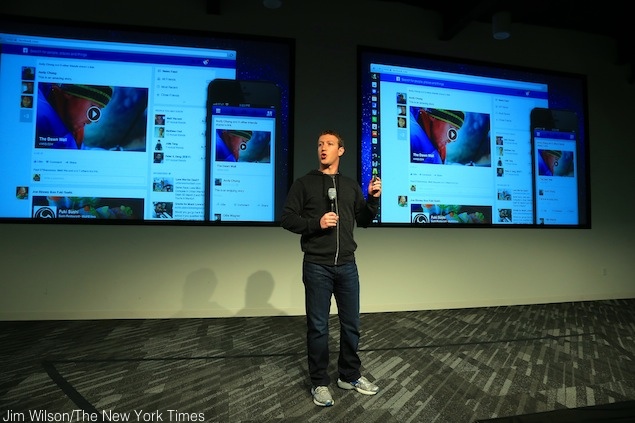
Hoping to tame the blizzard of information that has turned off many users and discouraged some advertisers, Facebook on Thursday unveiled a major makeover of the home page that greets users when they log into the site.
The new design of the Facebook News Feed presents bigger photos and links, including for advertisements, and lets users see specialized streams focused on topics like music and posts by close friends.
The changes are designed to address the company's two most vital challenges: how to hold on to users at a time of competing, specialized social networks and how to draw more advertising dollars to please Wall Street.
Mark Zuckerberg, the company's co-founder and chief executive, said at a news conference that he wanted Facebook to be "the best personalized newspaper in the world." And like a newspaper editor, he wants the "front page" of Facebook to be more engaging - in particular on the smaller screens of mobile devices.
The topic-specific News Feeds could well persuade users to spend more time scrolling through various streams of content. And the redesign will offer bigger real estate for advertisers, including more opportunities for brands to feature bigger pictures, which marketers say are more persuasive than words.
Facebook's proprietary algorithms, which try to guess what every user will want to see, will continue to filter the items that show up on each person's main News Feed. And users will be able to drill down into specific topics they are interested in, akin to the sections of a newspaper.
For instance, they can switch over to specialized feeds that are focused on just the music they are interested in, or they can scroll through a feed that consists of posts from the pages of products and people they follow - a bit like Twitter. If they want to see everything that their friends have posted, they can choose to do that, too; those posts will rush down in chronological order, without any filtering by Facebook's robots.
Facebook introduced the new design to some users of the Web version of its service Thursday and will extend it to all Web users and to mobile apps in coming weeks.
It's unclear how users will react to the changes; in the past, major design changes have often been greeted by complaints, at least initially.
Investors seemed to welcome the new look. Shares of Facebook rose 4.1 percent Tuesday, to $28.58. But the company's stock price remains substantially lower than its $38 initial public offering price last May.
Facebook is clearly hoping the new format will encourage users to stay longer on the site. At the news conference to announce the changes, officials offered examples of content they hoped would be compelling photos of a cousin's babies on one area of the page, Justin Timberlake concert news on another, a list of stories your friends liked on National Public Radio on still another.
"The best personalized newspaper should have a broad diversity of content," Zuckerberg said. "The most important stuff is going to be on the front page," he went on. "Then people have a chance to dig in."
The announcement met with swift praise from the advertising industry. In addition to bigger ad formats, the redesign's specialized content streams could keep users glued to the site longer, marketers said.
"This will result in more time spent overall on the Facebook News Feed - and of course, increase engagement with content and ads," said Hussein Fazal, chief executive of AdParlor, which buys advertisements on Facebook on behalf of several brands.
Facebook executives suggested that there would be no immediate changes to the number of advertisements that appear on the News Feed.
Julie Zhou, the company's design chief, said only that ads would be more visual. "Everything across the board is going to get this richer, more immersive design," Zhou said.
The redesign is also a nod to the ubiquity of mobile devices, which a majority of Facebook's 1 billion users worldwide use to log into their accounts. Pictures will show up bigger in the News Feed, and there will be larger images of maps and links to articles. In that way, the new look is a nod to other social networks that are seeing viral growth, like Pinterest, which is built around large pictures.
The new News Feed emphasizes the importance of photographs, which are one of Facebook's most underexploited assets. Zuckerberg said half of all News Feed posts were pictures, compared with about a quarter of all posts a year ago. Every day, 350 million pictures are uploaded to Facebook by individual users and brands.
The new design is virtually identical on the desktop and on tablets and cellphones.
Colin Sebastian, an analyst at Robert W. Baird, said the changes were positive for the company. "We see this as more likely enhancing the longer-term value of Facebook for both users and advertisers rather than adding materially to financial performance in the very near term," he said.
Users weighed in on Twitter.
"Not sure if (AT)facebook is merchandising our attention or Zuckerberg cares about our reading habits," Daixin Neill-Quan, a self-described Boston University senior, posted after the news.
Others pointed out that Flipboard, a popular app, already offers a personalized newspaper in which users choose the topics and publications they are interested in.
Siva Vaidhyanathan, chairman of the media studies department at the University of Virginia, said the redesign could help educate users as to just how much Facebook's algorithms filter what they see on what they think of as their social network.
"Users will at least be under less of an illusion that what's happening on Facebook is merely a function of what their friends are doing," he said. "Facebook is the puppet master of our social network."
© 2013, The New York Times News Service
Comments
For the latest tech news and reviews, follow Gadgets 360 on X, Facebook, WhatsApp, Threads and Google News. For the latest videos on gadgets and tech, subscribe to our YouTube channel. If you want to know everything about top influencers, follow our in-house Who'sThat360 on Instagram and YouTube.
Related Stories



Advertisement

Follow Us

-

04:42
Sonos Ace: The First Headphones By Luxury Audio Brand Sonos. Long Term Review -
00:55
Gadgets 360 With Technical Guruji: Enhance Your Phone's Charging Speed -
02:21
Gadgets 360 With Technical Guruji: Samsung Galaxy A26 5G -
02:34
Gadgets 360 With Technical Guruji: iQOO Z10 -
00:54
Gadgets 360 With Technical Guruji: News of the Week [April 12, 2024]
-
Moto Pad 60 Pro टैबलेट 10,200mAh बैटरी, 3K 144Hz डिस्प्ले के साथ लॉन्च
-
Red Magic 10 Air होगा 23 अप्रैल को ग्लोबली लॉन्च, जानें स्पेसिफिकेशंस
-
200MP कैमरा के साथ लॉन्च होंगे Honor 400, 400 Pro फोन! स्पेसिफिकेशन लीक
-
12 अप्रैल को 5 घंटे के लिए भारत में UPI इसलिए हो गया था डाउन...
-
50 मेगापिक्सल कैमरा, 5000mAh बैटरी के साथ Samsung Galaxy M56 5G लॉन्च, जानें कीमत और फीचर्स
Advertisement
Popular on Gadgets
- Samsung Galaxy Unpacked 2025
- ChatGPT
- Redmi Note 14 Pro+
- iPhone 16
- Apple Vision Pro
- Oneplus 12
- OnePlus Nord CE 3 Lite 5G
- iPhone 13
- Xiaomi 14 Pro
- Oppo Find N3
- Tecno Spark Go (2023)
- Realme V30
- Best Phones Under 25000
- Samsung Galaxy S24 Series
- Cryptocurrency
- iQoo 12
- Samsung Galaxy S24 Ultra
- Giottus
- Samsung Galaxy Z Flip 5
- Apple 'Scary Fast'
- Housefull 5
- GoPro Hero 12 Black Review
- Invincible Season 2
- JioGlass
- HD Ready TV
- Laptop Under 50000
- Smartwatch Under 10000
- Latest Mobile Phones
- Compare Phones
Latest Gadgets
- Samsung Galaxy M56 5G
- HMD 150 Music
- HMD 130 Music
- Honor Power
- Honor GT
- Acer Super ZX Pro
- Acer Super ZX
- Motorola Edge 60 Stylus
- Moto Book 60
- HP Omen Max 16
- Moto Pad 60 Pro
- Samsung Galaxy Tab Active 5 Pro
- Oppo Watch X2 Mini
- Garmin Instinct 3 Solar
- Xiaomi X Pro QLED 2025 (43-Inch)
- Xiaomi X Pro QLED 2025 (55-Inch)
- Nintendo Switch 2
- Sony PlayStation 5 Pro
- Whirlpool 1.5 Ton 3 Star Inverter Split AC (SAI18K38DC0)
- Whirlpool 1.5 Ton 5 Star Inverter Split AC (SAI17B54SED0)

- About Us
- Sitemaps
- Feedback
- Archives
- Contact Us
- RSS
- Advertise
- Career
- Privacy Policy
- Ethics
- Editorial Policy
- Terms & Conditions
- Complaint Redressal
Download Our Apps
Available in Hindi
© Copyright Red Pixels Ventures Limited 2025. All rights reserved.


