





-
 Facebook Introduces Friends Tab Without Recommended Content as Part of 'OG' Revamp28 March 2025
 -
Apple Said to Face French Antitrust Fine for Privacy Control Tool28 February 2025
-
Facebook Profile Lock: How to Lock Your FB Profile on Mobile, Desktop, Benefits, and More25 February 2025
-
Meta to Allow Rival Ads Providers to List on Facebook Marketplace After EU Antitrust Fine14 February 2025
-
Meta Prepares for Layoffs on Monday, Circulates Internal Memo10 February 2025
- Home
- Social networking
- Social networking News
- A titan's how to on breaking the glass ceiling
A titan's how-to on breaking the glass ceiling
By Jodi Kantor, The New York Times | Updated: 22 February 2013 10:50 IST
Advertisement
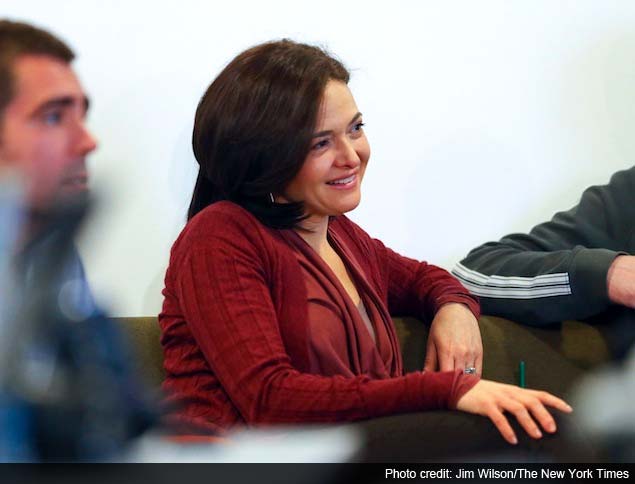
Before Sheryl Sandberg, the chief operating officer of Facebook, started to write "Lean In," her book-slash-manifesto on women in the workplace, she reread Betty Friedan's "The Feminine Mystique." Like the homemaker-turned-activist who helped start a revolution 50 years ago, Sandberg wanted to do far more than sell books.
Sandberg, whose ideas about working women have prompted both enthusiasm and criticism, is attempting nothing less than a Friedan-like feat: a national discussion of a gender problem that has no name, this time in the workplace, and a movement to address it.
When her book is published March 11, accompanied by a carefully orchestrated media campaign, she hopes to create her own version of the consciousness-raising groups of yore: "Lean In Circles," as she calls them, in which women can share experiences and follow a Sandberg-crafted curriculum for career success. (First assignment: a video on how to command more authority at work by changing how they speak and even sit.)
"I always thought I would run a social movement," Sandberg, 43, said in an interview for "Makers," a new documentary on feminist history.
And yet no one knows whether women will show up for Sandberg's revolution, a top-down affair propelled by a fortune worth hundreds of millions on paper, or whether the social media executive can form a women's network of her own. Only a single test "Lean In Circle" exists.
With less than three weeks until launch - which will include a spread in Time magazine and splashy events like a book party at New York City Mayor Michael R. Bloomberg's home - organizers cannot say how many more groups may sprout up.
Even her advisers acknowledge the awkwardness of a woman with double Harvard degrees, dual stock option riches (from Facebook and Google, where she also worked), a 9,000-square-foot house and a small army of household help urging less fortunate women to look inward and work harder.
Will more earthbound women, struggling with cash flow and child care, embrace the advice of a Silicon Valley executive whose book acknowledgments include thanks to her wealth adviser and Oprah Winfrey?
"I don't think anyone has ever tried to do this from anywhere even close to her perch," said Debora L. Spar, president of Barnard College, who invited Sandberg to deliver a May 2011 commencement address about gender in the workplace that caught fire online. (Sandberg, who will grant her first book interview to the CBS program "60 Minutes," declined to comment for this article.)
Despite decades of efforts, and some visible exceptions, the number of top women leaders in many fields remains stubbornly low. For example, 21 of the current Fortune 500 chief executives are women.
In her book, to be published by Knopf, Sandberg argues that is because women face invisible, even subconscious, barriers in the workplace, and not just from bosses. In her view, women are also sabotaging themselves.
"We hold ourselves back in ways both big and small, by lacking self-confidence, by not raising our hands, and by pulling back when we should be leaning in," she writes, and the result is that "men still run the world."
Sandberg wants to take women through a collective self-awareness exercise. In her book, she urges them to absorb the social science showing they are judged more harshly and paid less than men; resist slowing down in mere anticipation of having children; insist that their husbands split housework equally; draft short- and long-term career plans; and join a "Lean In" circle, which is half business school and half book club.
The project has the feel of a social experiment: What if women at major corporations could review research on how to overcome gender barriers, along with instruction on skills like negotiation and communication? Will working women, already stretched thin, attend nighttime video lectures on "Unconditional Responsibility" and "Using Stories Powerfully"?
The instructions for the gatherings, provided to The New York Times by an outside adviser to the project, are precise, down to membership requirements (participants can miss no more than two monthly meetings per year) and the format (15-minute check in, three minutes each for personal updates, a 90-minute presentation, then discussion.)
Sandberg has asked a wide array of women to contribute their success stories to her new website. (Jill Abramson, the executive editor of The Times, wrote an essay, and the newspaper is one of many corporations to sign on to the project.) The written requests ask for positive endings, suggesting that tales closing with missed promotions or broken marriages are unwelcome.
Hoping to reach beyond an elite audience, Sandberg and her foundation joined forces with Cosmopolitan magazine, which is publishing a 40-page supplement to its April issue devoted to Sandberg's ideas, and plan to spread her message to community colleges, according to those involved in the project.
But criticism is also starting to build: that Sandberg places too much of the onus on women who are already struggling to fulfill impossible demands, and too little on government and employers to provide better child care, more flexible jobs and other concrete gains.
Sandberg "does what too many successful women before her have done: blaming other women for not trying hard enough," Avivah Wittenberg-Cox, a consultant who works with companies to improve their gender balance, wrote after watching a video of Sandberg speaking on the topic at the World Economic Forum in Davos last month.
"Every resistant man on the planet will be able to quote her" saying that women simply must become more ambitious, Cox continued. (Sandberg writes that she focuses on internal barriers because the external ones get more attention.)
Sandberg's project, according to members of her launch committee and their solicitations, asks little of the corporations signing on as "launch partners," which include American Express, Google, Sony, Johnson & Johnson and multiple media businesses; mostly that they lend their logo to Lean In and distribute its materials to employees. In exchange, they will get recognition for supporting the Lean In cause, the solicitation says.
Sandberg's chief critic has been Anne-Marie Slaughter, a Princeton professor and former top State Department official, who published an Atlantic Magazine article titled "Why Women Can't Have It All," last year arguing that feminism - and Sandberg - were holding women to unattainable standards for personal and professional success.
Since then, both women quietly developed perhaps the most notable feminist row since Friedan refused to shake Gloria Steinem's hand decades ago.
According to several people who have spoken to both women, Sandberg felt blindsided by Slaughter's criticisms, and although they briefly exchanged emails, Sandberg stopped replying and refused joint speaking appearances.
Slaughter continued her commentary.
"Sheryl Sandberg is both superhuman and rich," she told Fortune magazine, implying that her advice makes little sense for anyone who is not.
"She's made a real contribution with the book, but it's only half the story," Slaughter said in an interview.
The Slaughter-Sandberg match may represent what some may see as a welcome new phase in the debate over work and motherhood. The "mommy wars," with working and stay-at-home mothers sniping at one another's choices, to no clear end, may have finally run their course.
Instead, Sandberg, Slaughter and many others are arguing about the best strategy for fulfilling feminism's promise.
"If you tell women to look inside themselves, you're letting the corporations and government off the hook," said Spar, the Barnard president, and "if you focus on the corporations and the governments, you're not being realistic."
Sandberg, who wrote a senior thesis at Harvard on the correlation between domestic violence and women's income, and who has championed women at Google and Facebook, shows no sign of relenting. On top of running a major company and rearing two young children - her second husband, Dave Goldberg, is chief executive of SurveyMonkey, another technology company - she has thrown herself into her new project.
Although she insists she is committed to Facebook, which might be awkward for her to leave given its rocky initial public offering, some wonder whether "Lean In" is the first step toward a new career for her, perhaps in politics.
"She is using all of her social capital on this," said Rachel Sklar, founder of a networking list for women in technology, who is on the Lean In launch committee.
Asked how Sandberg would balance her demanding job with the creation of a new movement, a member of the team offered a tentative answer: She plans to use her vacation days.
© 2013, The New York Times News Service
Comments
For the latest tech news and reviews, follow Gadgets 360 on X, Facebook, WhatsApp, Threads and Google News. For the latest videos on gadgets and tech, subscribe to our YouTube channel. If you want to know everything about top influencers, follow our in-house Who'sThat360 on Instagram and YouTube.
Related Stories




Advertisement

Follow Us

-

01:18
Gadgets 360 With Technical Guruji: Did You Know This About the Firefox Logo? -
02:23
Gadgets 360 With Technical Guruji: Hands on With the Samsung Galaxy Book5 Pro 360 -
02:23
Gadgets 360 With Technical Guruji: A Quick Look at the Google Pixel 9a -
01:31
Gadgets 360 With Technical Guruji: Scanning Documents Without Third-Party Apps -
02:40
Gadgets 360 With Technical Guruji: News of the Week [March 29, 2025]
-
WhatsApp लाया iOS यूजर्स के लिए बड़े काम का फीचर, जानें कैसे
-
Redmi A5 स्मार्टफोन 5200mAh बैटरी, 32MP कैमरा के साथ हुआ लॉन्च, जानें
-
OnePlus 13 vs Poco F7 Ultra: जानें कौन सा फोन है बेस्ट
-
iQOO Z10x होगा 11 अप्रैल को पेश, डिजाइन और फीचर्स आए सामने
-
Vivo का V50e जल्द होगा भारत में लॉन्च, 50 मेगापिक्सल का सेल्फी कैमरा
Advertisement
Popular on Gadgets
- Samsung Galaxy Unpacked 2025
- ChatGPT
- Redmi Note 14 Pro+
- iPhone 16
- Apple Vision Pro
- Oneplus 12
- OnePlus Nord CE 3 Lite 5G
- iPhone 13
- Xiaomi 14 Pro
- Oppo Find N3
- Tecno Spark Go (2023)
- Realme V30
- Best Phones Under 25000
- Samsung Galaxy S24 Series
- Cryptocurrency
- iQoo 12
- Samsung Galaxy S24 Ultra
- Giottus
- Samsung Galaxy Z Flip 5
- Apple 'Scary Fast'
- Housefull 5
- GoPro Hero 12 Black Review
- Invincible Season 2
- JioGlass
- HD Ready TV
- Laptop Under 50000
- Smartwatch Under 10000
- Latest Mobile Phones
- Compare Phones
Latest Gadgets
- Huawei Pura X
- Redmi A5
- Vivo Y300t
- Vivo Y300 Pro+
- Vivo Y300i
- Realme 14 5G
- Poco F7 Ultra
- Poco F7 Pro
- Acer TravelLite (2025)
- Asus Zenbook 14 (2025)
- Honor Pad X9a
- Lenovo Idea Tab Pro
- Oppo Watch X2
- Amazfit Bip 6
- Haier M80F Mini LED 4K
- Haier M95E
- Sony PlayStation 5 Pro
- Sony PlayStation 5 Slim Digital Edition
- Blue Star 1.5 Ton 3 Star Inverter Split AC (IC318DNUHC)
- Blue Star 1.5 Ton 3 Star Inverter Split AC (IA318VKU)

- About Us
- Sitemaps
- Feedback
- Archives
- Contact Us
- RSS
- Advertise
- Career
- Privacy Policy
- Ethics
- Editorial Policy
- Terms & Conditions
- Complaint Redressal
Download Our Apps
Available in Hindi
© Copyright Red Pixels Ventures Limited 2025. All rights reserved.