
- Home
- Others
- Others News
- Pay for potato chips with your fingerprint at this college
Pay for potato chips with your fingerprint at this college
By Associated Press | Updated: 22 February 2013 16:57 IST
Advertisement
Futurists have long proclaimed the coming of a cashless society, where dollar bills and plastic cards are replaced by fingerprint and retina scanners smart enough to distinguish a living, breathing account holder from an identity thief.
What they probably didn't see coming was that one such technology would make its debut not in Silicon Valley or MIT but at a small state college in remote western South Dakota, 25 miles from Mount Rushmore.
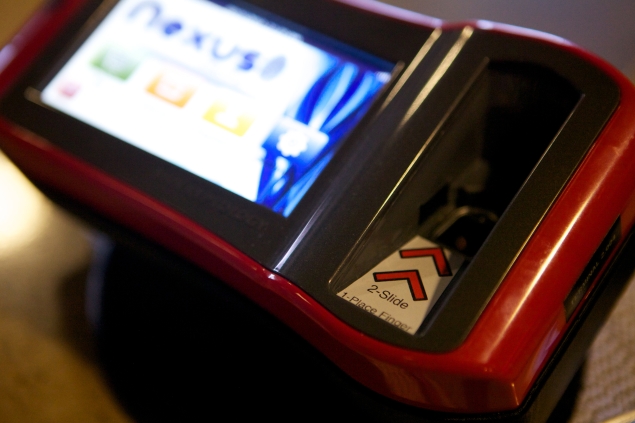
Two shops on the School of Mines and Technology campus are performing one of the world's first experiments in Biocryptology - a mix of biometrics (using physical traits for identification) and cryptology (the study of encoding private information). Students at the Rapid City school can buy a bag of potato chips with a machine that non-intrusively detects their hemoglobin to make sure the transaction is legitimate.
Researchers figure their technology would provide a critical safeguard against a morbid scenario sometimes found in spy movies in which a thief removes someone else's finger to fool the scanner.
On a recent Friday, mechanical engineering major Bernard Keeler handed a Red Bull to a cashier in the Miner's Shack campus shop, typed his birthdate into a pay pad and swiped his finger. Within seconds, the machine had identified his print and checked that blood was pulsing beneath it, allowing him to make the buy. Afterward, Keeler proudly showed off the receipt he was sent via email on his smartphone.
Fingerprint technology isn't new, nor is the general concept of using biometrics as a way to pay for goods. But it's the extra layer of protection - that deeper check to ensure the finger has a pulse - that researchers say sets this technology apart from already-existing digital fingerprint scans, which are used mostly for criminal background checks.
Al Maas, president of Nexus USA - a subsidiary of Spanish-based Hanscan Indentity Management, which patented the technology - acknowledged South Dakota might seem an unlikely locale to test it, but to him, it was a perfect fit.
"I said, if it flies here in the conservative Midwest, it's going to go anywhere," Maas said.
Maas grew up near Madison, S.D., and wanted his home state to be the technology's guinea pig. He convinced Hanscan owner Klaas Zwart that the 2,400-student Mines campus should be used as the starter location.
The students all major in mechanical engineering or hard sciences, which means they're naturally technologically inclined, said Joseph Wright, the school's associate vice president for research-economic development.
"South Dakota is a place where people take risks. We're very entrepreneurial," Wright said.
After Maas and Zwart introduced the idea to students this winter, about 50 stepped forward to take part in the pilot.
"I really wanted to be part of what's new and see if I could help improve what they already have," said Phillip Clemen, 19, a mechanical engineering student.
Robert Siciliano, a security expert with McAfee, Inc., minimized potential privacy concerns.
"We are hell bent on privacy issues here in the U.S. We get all up in arms when someone talks about scanning us or recording our information, but then we'll throw up everything about us on Facebook and give up all of our personal information for 10 percent off at a shoe store for instant credit," he said.
Jay Stanley, senior policy analyst with the American Civil Liberties Union, said fingerprint technology on its own raises security issues, but he called "liveness detection" a step in the right direction.
"Any security measure can be defeated; it's a question of making it harder," he said.
The key to keeping biometric identification from becoming Big Brother-like is to make it voluntary and ensure that the information scanned is used exactly as promised, Stanley said.
Brian Wiles, a Miles mechanical engineering major, said it's exciting to be beta testing technology that could soon be worldwide.
"There was some hesitation, but the fact that it's the first in the world - that's the whole point of this school," said Wiles, 22. "We're innovators."
Comments
For the latest tech news and reviews, follow Gadgets 360 on X, Facebook, WhatsApp, Threads and Google News. For the latest videos on gadgets and tech, subscribe to our YouTube channel. If you want to know everything about top influencers, follow our in-house Who'sThat360 on Instagram and YouTube.


Advertisement
Follow Us




-

03:30
How OPPO's LinkBoost Improves Network Connectivity -
02:59
Gadgets360 With Technical Guruji: Ask TG [April 13, 2024] -
02:24
Gadgets360 With Technical Guruji: Tech Tip [April 13, 2024] -
02:00
Gadgets360 With Technical Guruji: Did You Know [April 13, 2024] -
05:05
Gadgets360 With Technical Guruji: Samsung Launches Bespoke AI-Powered Home Appliances
-
12GB RAM, 5000mAh की बैटरी के साथ Oppo A1s और Oppo A1i लॉन्च, जानें सबकुछ
-
Moto G64 5G स्मार्टफोन भारत में लॉन्च, Rs 15 हजार में 50MP कैमरा
-
Vivo V30e के स्पेसिफिकेशंस लीक, सोनी IMX882 OIS कैमरा के साथ देगा दस्तक
-
OnePlus 11R सोलर रेड कलर मॉडल हुआ लॉन्च, 8GB रैम, 5000mAh बैटरी, 100W चार्जिंग जैसे फीचर्स
-
iPhone 15 पर यहां मिल रहा है Rs. 13,991 का जबरदस्त डिस्काउंट, बैंक ऑफर अलग से...
Advertisement
Popular on Gadgets
- Galaxy S24 Series
- MWC 2024
- Apple Vision Pro
- Oneplus 12
- iPhone 14
- Apple iPhone 15
- OnePlus Nord CE 3 Lite 5G
- iPhone 13
- Xiaomi 14 Pro
- Oppo Find N3
- Tecno Spark Go (2023)
- Realme V30
- Best Phones Under 25000
- Samsung Galaxy S24 Series
- Cryptocurrency
- iQoo 12
- Samsung Galaxy S24 Ultra
- Giottus
- Samsung Galaxy Z Flip 5
- Apple 'Scary Fast'
- Housefull 5
- GoPro Hero 12 Black Review
- Invincible Season 2
- JioGlass
- HD Ready TV
- Laptop Under 50000
- Smartwatch Under 10000
- Latest Mobile Phones
- Compare Phones
Latest Gadgets
- Motorola Edge 50 Fusion
- Oppo A1i
- Oppo A1s
- Motorola Edge 50 Ultra
- Leica Leitz Phone 3
- Moto G64 5G
- Moto G04s
- iQOO Z9 Turbo
- Asus ZenBook Duo 2024 (UX8406)
- Dell Inspiron 14 Plus
- Realme Pad 2 Wi-Fi
- Redmi Pad Pro
- Cult Shock X
- Fire-Boltt Oracle
- LG 65-inch 4K Ultra HD Smart LED TV 65UR7500PSC
- Xiaomi 32 Inch LED HD Ready Smart TV (L32M6-RA-L32M7-RA)
- Sony PlayStation 5 Slim Digital Edition
- Sony PlayStation 5 Slim
- Onida 1.5 Ton 3 Star Inverter Split AC (IR183TSN)
- Haier 1.5 Ton 3 Star Window AC (HWU18TF-EW3BE-FS)

- About Us
- Sitemaps
- Feedback
- Archives
- Contact Us
- RSS
- Advertise
- Career
- Privacy Policy
- Ethics
- Editorial Policy
- Terms & Conditions
- Complaint Redressal
Download Our Apps
Available in Hindi
© Copyright Red Pixels Ventures Limited 2024. All rights reserved.


