-
 Mars May Have Been Habitable in the Past, NASA Rover Observations Suggest Water Presence: Scientists10 August 2023
 -
The 7 Biggest Web Series and TV Shows in October on Netflix, Hotstar, Apple TV+, and Prime Video4 October 2022
-
Netflix October 2022 Releases: Mismatched Season 2, Ranga Ranga Vaibhavanga, and More28 September 2022
-
NASA’s Curiosity Rover Completes 10 Years of Exploring Mars — Here’s What It Has Found So Far8 August 2022
-
NASA’s Curiosity and Perseverance Rovers Must Dig Deeper for Signs of Ancient Life on Mars, Say Researchers28 June 2022

- Home
- Others
- Others News
- NASA Mars rover ready to eat, analyze rock powder
NASA Mars rover ready to eat, analyze rock powder
By Reuters | Updated: 15 April 2013 13:17 IST
Advertisement
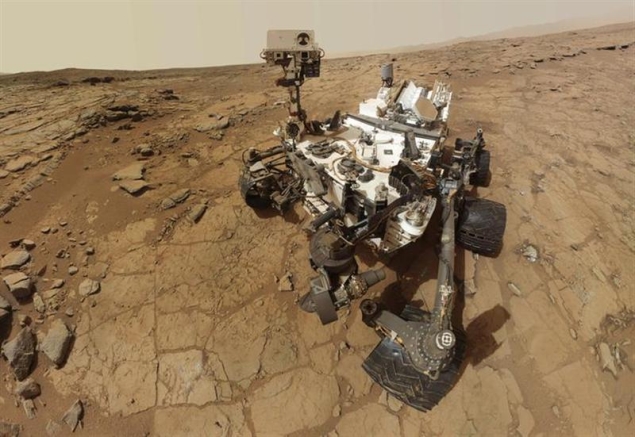
NASA's Mars rover Curiosity, dispatched to learn if the planet ever had ingredients for life, drilled its first bit of powder from inside a potentially water-formed ancient rock, scientists said on Wednesday.
The robotic geology station, which landed inside a giant impact basin on August 6 for a two-year mission, transferred about a tablespoon of rock powder from its drill into a scoop, pictures relayed by the rover Wednesday showed.
"We're all very happy to get this confirmation and relieved that the drilling was a complete success," Curiosity engineer Scott McCloskey of NASA's Jet Propulsion Laboratory in Pasadena, California, told reporters on a conference call.
On February 8, the rover used its powerful drill, the first instrument of its type to be sent to Mars, to bore inside a flat, veined piece of bedrock, which appears to contain minerals formed by flowing water.
The sample, retrieved from at least 2 inches (5 cm) beneath the surface of the rock, will be sieved and portions of it processed inside two onboard science instruments.
The gray powder is strikingly different than the ubiquitous red dust that covers the planet's surface, a result of oxidation from solar ultraviolet radiation.
"Having a rock-drilling capability on a rover is a significant advancement," said Louise Jandura, chief engineer for Curiosity's sample system.
"It allows us to go beyond the surface layer of the rock, unlocking a kind of time capsule of evidence about the state of Mars going back 3 or 4 billion years," Jandura told reporters.
The drill is the last of Curiosity's 10 science instruments to be tested since the rover landed inside Gale Crater, located near the planet's equator.
The site was selected because of a three-mile (5-km) high mound of what appears to be layered sediments rising from the crater's floor.
Rather than driving directly over to the mountain, scientists decided to explore an area in the opposite direction that showed intriguing signs of past water.
Water is believed to be a key ingredient for life.
"The rocks in this area have a really rich geologic history and they have the potential to give us information about multiple interactions of water and rock," said Curiosity scientist Joel Hurowitz, also with the Jet Propulsion Laboratory.
The fine-grained rocks are filled with veins and spherical deposits, including what appears to be calcium sulfate, a mineral which forms on Earth when water flows through fractures in rock. Mars is the planet in our solar system most like Earth.
"When you find exactly these sorts of conditions on Earth ... and everything still goes right, it's still an accident of fate to preserve organics," Curiosity's lead scientist John Grotzinger of the California Institute of Technology in Pasadena told Reuters.
"So we'll have to separate at some point the pursuit of what may have been a habitable environment from what may or may not be an environment that preserves organics," he said.
"Obviously we're interested in the organics but right now we're sort of on the pathway to hopefully characterizing this place as a habitable environment," Grotzinger said.
© Thomson Reuters 2013
Comments
For the latest tech news and reviews, follow Gadgets 360 on X, Facebook, WhatsApp, Threads and Google News. For the latest videos on gadgets and tech, subscribe to our YouTube channel. If you want to know everything about top influencers, follow our in-house Who'sThat360 on Instagram and YouTube.
Related Stories





Advertisement
Follow Us




-
 Vivo V30e 5G भारत में 5500mAh बैटरी, 44W फास्ट चार्जिंग के साथ होगा लॉन्च
 -
Moto E14 में होगी 5000mAh बैटरी, TDRA सर्टिफिकेशन में दिखा फोन
-
OnePlus Ace 3 Pro के स्पेसिफिकेशंस, डिजाइन का हुआ खुलासा, क्या होगा खास
-
Xiaomi ने लॉन्च किया मोबाइल से कंट्रोल होने वाला स्मार्ट वाटर हीटर, इसमें एंटीबैक्टीरियल टेक्नोलॉजी भी मिलती है
Advertisement
Popular on Gadgets
- Galaxy S24 Series
- MWC 2024
- Apple Vision Pro
- Oneplus 12
- iPhone 14
- Apple iPhone 15
- OnePlus Nord CE 3 Lite 5G
- iPhone 13
- Xiaomi 14 Pro
- Oppo Find N3
- Tecno Spark Go (2023)
- Realme V30
- Best Phones Under 25000
- Samsung Galaxy S24 Series
- Cryptocurrency
- iQoo 12
- Samsung Galaxy S24 Ultra
- Giottus
- Samsung Galaxy Z Flip 5
- Apple 'Scary Fast'
- Housefull 5
- GoPro Hero 12 Black Review
- Invincible Season 2
- JioGlass
- HD Ready TV
- Laptop Under 50000
- Smartwatch Under 10000
- Latest Mobile Phones
- Compare Phones
Latest Gadgets
- Huawei Pura 70 Pro
- Huawei Pura 70
- Vivo V30e
- Itel Super Guru 4G
- Huawei Pura 70 Pro+
- Huawei Pura 70 Ultra
- Tecno Camon 30 Premier 5G
- Motorola Edge 50 Fusion
- Asus ZenBook Duo 2024 (UX8406)
- Dell Inspiron 14 Plus
- Realme Pad 2 Wi-Fi
- Redmi Pad Pro
- Cult Shock X
- Fire-Boltt Oracle
- Samsung Samsung Neo QLED 8K Smart TV QN800D
- Samsung Neo QLED 4K Smart TV (QN90D)
- Sony PlayStation 5 Slim Digital Edition
- Sony PlayStation 5 Slim
- Voltas 1.5 Ton 3 Star Split AC (183 Vectra Elegant 4503545)
- Hitachi 1.5 Ton 5 Star Inverter Split AC (RAS.G518PCBISF)

- About Us
- Sitemaps
- Feedback
- Archives
- Contact Us
- RSS
- Advertise
- Career
- Privacy Policy
- Ethics
- Editorial Policy
- Terms & Conditions
- Complaint Redressal
Download Our Apps
Available in Hindi
© Copyright Red Pixels Ventures Limited 2024. All rights reserved.


