-
 Curiosity Rover Finds Evidence of Liquid Water on Mars, Expanding Habitability Timeline18 February 2025
 -
Curiosity Rover Observes Iridescent Clouds on Mars, Offering New Insights14 February 2025
-
NASA’s Curiosity Rover Captures Stunning Feather-Shaped Iridescent Cloud on Mars14 February 2025
-
NASA's Curiosity Rover Explores Mars' Texoli Butte Amid New Challenges18 December 2024
-
NASA’s Curiosity Rover Set to Target Spiderweb-Like 'Boxworks Deposits' on Mars' Surface30 November 2024
- Home
- Others
- Others News
- NASA aims to launch Mars rover twin in 2020
NASA aims to launch Mars rover twin in 2020
By Reuters | Updated: 5 December 2012 12:11 IST
Advertisement
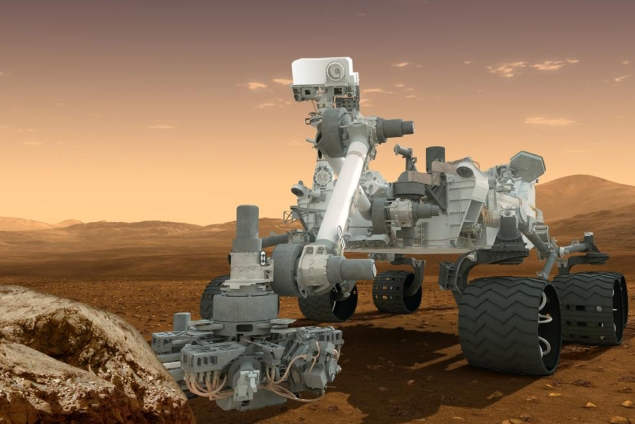
NASA plans to follow up its Mars rover Curiosity mission with a duplicate rover that could collect and store samples for return to Earth, the agency's lead scientist said on Tuesday.
The new rover will use spare parts and engineering models developed for Curiosity, which is four months into a planned $2.5 billion mission on Mars to look for habitats that could have supported microbial life.
Replicating the rover's chassis, sky-crane landing system and other gear will enable NASA to cut the cost of the new mission to about $1.5 billion including launch costs, John Grunsfeld, the U.S. space agency's associate administrator for science, said at the American Geophysical Union conference in San Francisco.
Budget shortfalls forced NASA to pull out of a series of joint missions with Europe, designed to return rock and soil samples from Mars in the 2020s. Europe instead will partner with Russia for the launch vehicle and other equipment that was to have been provided by NASA.
Grunsfeld said NASA will provide a key organics experiment for Europe's ExoMars rover, as well as engineering and mission support under the agency's proposed budget for the year beginning October 1, 2013. T he United States also will provide the radio communications equipment for a planned European orbiter slated to launch in 2016.
Details about what science instruments would be included on the new rover, whether or not it would have a cache for samples, and the landing site have not yet been determined.
NASA plans to set up a team of scientists to refine plans for the rover and issue a solicitation next summer.
The National Academy of Sciences last year ranked a Mars sample return mission as its top priority in planetary science for the next decade.
"The (science) community already has come forward with a very clear message about what the content of the next Mars surface mission should be, and that is to cache the samples that will come back to Earth," said Steve Squyres with Cornell University.
"That's really a necessary part of having this mission," he said.
Humans missions to Mars
NASA had considered flying an orbiter in 2018, but decided instead to provide equipment for the European probes, extend its ongoing Mars missions and develop the Curiosity twin rover for launch in 2020. "We could have come up with something in 2018, but with the budget that we're in we would not have had such a full program. It would have been a down-scaled orbiter of some kind," Grunsfeld said.
Under the revamped Mars plan, Curiosity's two-year mission would be extended to five years.
The new rover also would help NASA prepare for eventual human missions to Mars, a long-term objective of the U.S. space program.
"If we think of the 2030s as the potential for human exploration, I think this 2020 rover and the other things we might be able to do in the 2020s as a synergistic collaboration between science and human spaceflight. There are a lot of cool things we can do," Grunsfeld said.
© Thomson Reuters 2012
Comments
For the latest tech news and reviews, follow Gadgets 360 on X, Facebook, WhatsApp, Threads and Google News. For the latest videos on gadgets and tech, subscribe to our YouTube channel. If you want to know everything about top influencers, follow our in-house Who'sThat360 on Instagram and YouTube.
Related Stories




Advertisement

Follow Us

-

01:18
Gadgets 360 With Technical Guruji: Did You Know This About the Firefox Logo? -
02:23
Gadgets 360 With Technical Guruji: Hands on With the Samsung Galaxy Book5 Pro 360 -
02:23
Gadgets 360 With Technical Guruji: A Quick Look at the Google Pixel 9a -
01:31
Gadgets 360 With Technical Guruji: Scanning Documents Without Third-Party Apps -
02:40
Gadgets 360 With Technical Guruji: News of the Week [March 29, 2025]
Advertisement
Popular on Gadgets
- Samsung Galaxy Unpacked 2025
- ChatGPT
- Redmi Note 14 Pro+
- iPhone 16
- Apple Vision Pro
- Oneplus 12
- OnePlus Nord CE 3 Lite 5G
- iPhone 13
- Xiaomi 14 Pro
- Oppo Find N3
- Tecno Spark Go (2023)
- Realme V30
- Best Phones Under 25000
- Samsung Galaxy S24 Series
- Cryptocurrency
- iQoo 12
- Samsung Galaxy S24 Ultra
- Giottus
- Samsung Galaxy Z Flip 5
- Apple 'Scary Fast'
- Housefull 5
- GoPro Hero 12 Black Review
- Invincible Season 2
- JioGlass
- HD Ready TV
- Laptop Under 50000
- Smartwatch Under 10000
- Latest Mobile Phones
- Compare Phones
Latest Gadgets
- Lava Bold 5G
- Huawei Pura X
- Motorola Edge 60 Fusion
- Redmi A5
- Vivo Y300t
- Vivo Y300 Pro+
- Vivo Y300i
- Realme 14 5G
- Acer TravelLite (2025)
- Asus Zenbook 14 (2025)
- Samsung Galaxy Tab S10 FE+
- Samsung Galaxy Tab S10 FE
- Garmin Vivoactive 6
- Oppo Watch X2
- Haier M80F Mini LED 4K
- Haier M95E
- Sony PlayStation 5 Pro
- Sony PlayStation 5 Slim Digital Edition
- LG 1.5 Ton 5 Star Inverter Window AC (UW-Q18WUZA)
- LG 1.5 Ton 3 Star Inverter Split AC (US-Q18JNXE)

- About Us
- Sitemaps
- Feedback
- Archives
- Contact Us
- RSS
- Advertise
- Career
- Privacy Policy
- Ethics
- Editorial Policy
- Terms & Conditions
- Complaint Redressal
Download Our Apps
Available in Hindi
© Copyright Red Pixels Ventures Limited 2025. All rights reserved.