





-
 Scientists at CERN's LHC Observe Three "Exotic" Particles for First Time6 July 2022
 -
100-Km Particle Accelerator Under Geneva Enters Race to Succeed Large Hadron Collider17 January 2019
-
LHC's New Particle Was Just a Fluke, Scientists Find8 August 2016
-
Physics Prepares to Feast on Collider Data, Seeking Dark Universe6 July 2016
-
World's Largest Particle Smasher Set to Push Physics Into Unknown7 May 2016
- Home
- Others
- Others News
- Higgs boson discovery confirmed
Higgs boson discovery confirmed
By Indo-Asian News Service | Updated: 15 March 2013 10:39 IST
Advertisement
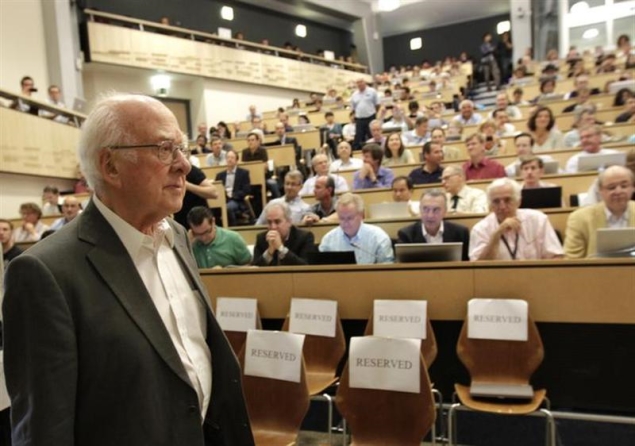
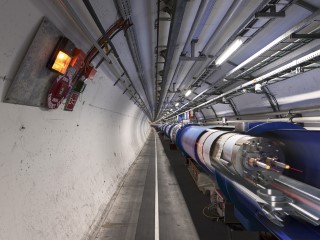
Researchers operating the Large Hadron Collider (LHC) particle accelerator have confirmed that a particle discovered in July 2012 is indeed the so-called Higgs boson, a key element in scientists' theories explaining the makeup of all the matter around us.
"The preliminary results with the full 2012 data set are magnificent and to me it is clear that we are dealing with a Higgs boson though we still have a long way to go to know what kind of Higgs boson it is," Joe Incandela, a spokesman for the CMS experiment at the collider, said at a scientific conference in Geneva.
"It remains an open question, however, whether this is the Higgs boson of the Standard Model of particle physics, or possibly the lightest of several bosons predicted in some theories that go beyond the Standard Model," said researchers at the European Organization for Nuclear Research, or CERN.
Scientists believe that the Higgs boson is the last discovered particle outlined by the Standard Model of particle physics, which explains the interaction of all subatomic particles.
It is one of the fundamental theories of modern physics, which is why it is sometimes called "the theory of almost everything".
More experiments and LHC data processing will follow to determine the full properties of the discovered particle, which is a daunting task considering that the detection of the boson is a very rare event - it takes around one trillion proton-proton collisions for each observed instance, according to CERN researchers.
The LHC, the world's biggest particle accelerator launched in 2008, was built with the prime goal of either finding the Higgs boson, whose existence was predicted by British physicist Peter Higgs in the 1960s, or disproving it, possibly undermining the Standard Model.
Comments
For the latest tech news and reviews, follow Gadgets 360 on X, Facebook, WhatsApp, Threads and Google News. For the latest videos on gadgets and tech, subscribe to our YouTube channel. If you want to know everything about top influencers, follow our in-house Who'sThat360 on Instagram and YouTube.
Related Stories

Advertisement

Follow Us

-

04:49
JisuLife Hand Fans, Neck Fans & Portable Fans: First Impressions -
01:14
Gadgets 360 With Technical Guruji: Tech Tip to Save iPhone Storage -
03:21
Gadgets 360 With Technical Guruji: Realme P3 Series Debuts -
01:32
Gadgets 360 With Technical Guruji: News of the Week [April 20, 2025] -
03:13
Gadgets 360 With Technical Guruji: Ask TG [April 20, 2025]
-
Vivo Watch 5 हुई लॉन्च, AMOLED डिस्प्ले के साथ 22 दिनों तक चलेगी बैटरी
-
Honor X60 GT फोन 16GB तक रैम, 6300mAh बैटरी, 50MP कैमरा के साथ हुआ लॉन्च
-
Vivo Pad 5 Pro, Pad SE टैबलेट लॉन्च, 13 इंच डिस्प्ले और 12050mAh बैटरी
-
Vivo X200 Ultra vs Vivo X200s: कौन सा फ्लैगशिप फोन है बेस्ट
-
Flipkart की IPO लाने की तैयारी, सिंगापुर से भारत शिफ्ट होगी होल्डिंग कंपनी
Advertisement
Popular on Gadgets
- Samsung Galaxy Unpacked 2025
- ChatGPT
- Redmi Note 14 Pro+
- iPhone 16
- Apple Vision Pro
- Oneplus 12
- OnePlus Nord CE 3 Lite 5G
- iPhone 13
- Xiaomi 14 Pro
- Oppo Find N3
- Tecno Spark Go (2023)
- Realme V30
- Best Phones Under 25000
- Samsung Galaxy S24 Series
- Cryptocurrency
- iQoo 12
- Samsung Galaxy S24 Ultra
- Giottus
- Samsung Galaxy Z Flip 5
- Apple 'Scary Fast'
- Housefull 5
- GoPro Hero 12 Black Review
- Invincible Season 2
- JioGlass
- HD Ready TV
- Laptop Under 50000
- Smartwatch Under 10000
- Latest Mobile Phones
- Compare Phones
Latest Gadgets
- Huawei Enjoy 80
- Oppo K12s
- Honor X60 GT
- Vivo T4 5G
- Vivo X200 Ultra
- Vivo X200s
- Oppo K13 5G
- Infinix Note 50s 5G+
- Asus Vivobook S14 Flip (2025, Intel Core i5)
- Asus Vivobook S14 (2025, Intel Core i5)
- Vivo Pad SE
- Vivo Pad 5 Pro
- Vivo Watch 5
- Redmi Watch Move
- Xiaomi X Pro QLED 2025 (43-Inch)
- Xiaomi X Pro QLED 2025 (55-Inch)
- Nintendo Switch 2
- Sony PlayStation 5 Pro
- Toshiba 1.8 Ton 5 Star Inverter Split AC (RAS-24TKCV5G-INZ / RAS-24TACV5G-INZ)
- Toshiba 1.5 Ton 5 Star Inverter Split AC (RAS-18PKCV2G-IN / RAS-18PACV2G-IN)

- About Us
- Sitemaps
- Feedback
- Archives
- Contact Us
- RSS
- Advertise
- Career
- Privacy Policy
- Ethics
- Editorial Policy
- Terms & Conditions
- Complaint Redressal
Download Our Apps
Available in Hindi
© Copyright Red Pixels Ventures Limited 2025. All rights reserved.


