-
 BlackBerry Records Profit in First Quarter Fueled by Growth in Its Cybersecurity Business29 June 2023
 -
Blackberry to Sell Patents for Mobile Devices in New $900 Million Deal After Sale to Catapult Collapses21 March 2023
-
BlackBerry IoT Unit Sees Increase in Automotive Demand Amid Fall in Cybersecurity Revenue28 September 2022
-
BlackBerry Plans to Settle Shareholder Lawsuit Over BlackBerry 10, Avoiding Trial7 April 2022
-
BlackBerry to Sell Patents Related to Mobile Devices, Messaging for $600 Million1 February 2022

- Home
- Mobiles
- Mobiles News
- RIM reports first ever dip in BlackBerry subscribers
RIM reports first-ever dip in BlackBerry subscribers
By Associated Press | Updated: 21 December 2012 09:47 IST
Advertisement
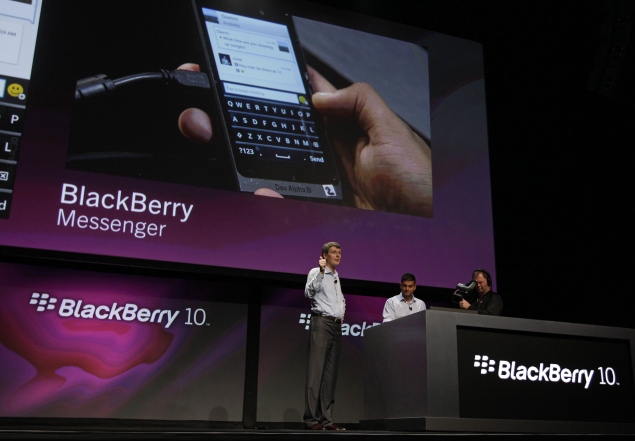
Research In Motion's stock plunged in after-hours trading Thursday after the BlackBerry maker said it plans to change the way it charges fees.
RIM also announced that it lost subscribers for the first time in the latest quarter, as the global number of BlackBerry users dipped to 79 million.
In a rare positive sign, the Canadian company added to its cash position during the quarter as it prepared to launch new smartphones on Jan. 30. The new devices are deemed critical to the company's survival.
RIM's stock initially jumped more than 8 percent in after-hours trading on that news, but then fell $1.48, or 10.4 percent, to $12.65 after RIM said on a conference call that it won't generate as much revenue from telecommunications carriers once it releases the new BlackBerry 10 platform.
RIM is changing the way it charges service fees, putting an important source of revenue at risk. RIM CEO Thorsten Heins said only subscribers who want enhanced security will pay fees under the new system.
"Other subscribers who do not utilize such services are expected to generate less or no service revenue," Heins said. "The mix in level of service fees revenue will change going forward and will be under pressure over the next year during this transition."
RIM's stock had been on a three-month rally that has seen the stock more than double from its lowest level since 2003.
But Mike Walkley, an analyst with Canaccord Genuity, said BlackBerry 10 will change RIM's services revenue model dramatically. He said that instead of getting about $6 per device each month from carriers and users RIM could get as little as zero.
"That's what turned the stock from being up 10 percent to being down 10 percent," Walkley said. "That's been part of our worry. How do they come back with a new platform and get carriers to continue to share the higher revenue -which sounds like they are not going to- and then subsidize the phone to make it affordable for consumers and enterprises."
"People are seeing that the services revenue has a lot of risk to it now with the BlackBerry 10 migration."
Three months ago, RIM had 80 million subscribers. Analysts said the loss of 1 million subscribers was expected. Once coveted symbols of an always-connected lifestyle, BlackBerry phones have lost their luster to Apple's iPhone and phones that run on Google's Android software.
RIM is banking its future on its much-delayed BlackBerry 10 platform, which is meant to offer the multimedia, Internet browsing and apps experience that customers now demand.
"We believe the company has stabilized and will turn the corner in the next year," Heins said. He noted that the company's cash holdings grew by $600 million in the quarter to $2.9 billion, even after the funding of all its restructuring costs. RIM previously announced 5,000 layoffs this year.
Heins said subscribers in North America showed the largest decline, but said there is growth overseas.
Colin Gillis, an analyst with BGC Financial, said before the conference call that the company bought itself more time.
"It doesn't mean (BlackBerry) 10 will gain traction. A lot of people said 10 would be DOA, but I don't think that's going to be the case," he said.
Jefferies analyst Peter Misek also earlier called the results better than expected, noting that RIM added a significant amount of cash. RIM will need the money to advertise the new BlackBerrys and operating system.
Misek also called it a positive development that RIM said there would not be another delay to BlackBerry 10.
"The success or failure of this company will be on BlackBerry 10," Misek said.
RIM posted net income of $14 million, or 3 cents per share for its fiscal third quarter, which ended Dec. 1. That compares with a profit of $265 million, or 51 cents per share, in the same quarter a year ago.
The latest figure includes a favorable tax settlement. Excluding that adjustment, RIM lost 22 cents per share. Analysts polled by FactSet were expecting a wider loss of 27 cents.
RIM reported revenue of $2.7 billion, down 47 percent from a year ago.
Comments
For the latest tech news and reviews, follow Gadgets 360 on X, Facebook, WhatsApp, Threads and Google News. For the latest videos on gadgets and tech, subscribe to our YouTube channel. If you want to know everything about top influencers, follow our in-house Who'sThat360 on Instagram and YouTube.
Related Stories



Advertisement
Follow Us




-

03:19
Gadgets 360 With Technical Guruji: Something About the Nothing Ear, Ear (a) -
19:21
Gadgets 360 With Technical Guruji: Samsung's New AI Smart TVs, Nothing Ear -
05:23
Gadgets 360 With Technical Guruji: Samsung's New AI Smart TVs -
01:17
Gadgets 360 With Technical Guruji: Tech Tip [April 20, 2024] -
02:05
Gadgets 360 With Technical Guruji: Ask TG [April 20, 2024]
Advertisement
Popular on Gadgets
- AI
- iPhone 16 Leaks
- Apple Vision Pro
- Oneplus 12
- iPhone 14
- Apple iPhone 15
- OnePlus Nord CE 3 Lite 5G
- iPhone 13
- Xiaomi 14 Pro
- Oppo Find N3
- Tecno Spark Go (2023)
- Realme V30
- Best Phones Under 25000
- Samsung Galaxy S24 Series
- Cryptocurrency
- iQoo 12
- Samsung Galaxy S24 Ultra
- Giottus
- Samsung Galaxy Z Flip 5
- Apple 'Scary Fast'
- Housefull 5
- GoPro Hero 12 Black Review
- Invincible Season 2
- JioGlass
- HD Ready TV
- Laptop Under 50000
- Smartwatch Under 10000
- Latest Mobile Phones
- Compare Phones
Latest Gadgets
- iQOO Z9x
- iQOO Z9
- HMD Pulse
- HMD Pulse+
- HMD Pulse Pro
- Realme Narzo 70x 5G
- Realme Narzo 70 5G
- Samsung Galaxy C55
- Lenovo IdeaPad Pro 5i
- Asus ZenBook Duo 2024 (UX8406)
- Realme Pad 2 Wi-Fi
- Redmi Pad Pro
- boAt Storm Call 3
- Lava ProWatch Zn
- Samsung Samsung Neo QLED 8K Smart TV QN800D
- Samsung Neo QLED 4K Smart TV (QN90D)
- Sony PlayStation 5 Slim Digital Edition
- Sony PlayStation 5 Slim
- Lloyd 1.5 Ton 3 Star Inverter Split AC (GLS18I3FOSEW)
- Haier 1.5 Ton 3 Star Triple Inverter Split AC (HSU18K-PYSS3BN-INV)

- About Us
- Sitemaps
- Feedback
- Archives
- Contact Us
- RSS
- Advertise
- Career
- Privacy Policy
- Ethics
- Editorial Policy
- Terms & Conditions
- Complaint Redressal
Download Our Apps
Available in Hindi
© Copyright Red Pixels Ventures Limited 2024. All rights reserved.


