





-
 Windows 11 Now Running on Over 400 Million Monthly Active Devices: Report18 October 2023
 -
Windows 10 Free Upgrade Loophole for Windows 7 and Windows 8 Users Finally Closed by Microsoft3 October 2023
-
Steam Is Ending Support for Windows 7, 8, and 8.1 in January 2024: Details28 March 2023
-
Lies of P Sets August Release Window, Drops New Trailer20 February 2023
-
Microsoft Announces Support For Windows 8.1 to End in January 202325 June 2022
- Home
- Laptops
- Laptops News
- Windows 8 selling well despite PC slump: Microsoft
Windows 8 selling well despite PC slump: Microsoft
By Associated Press | Updated: 29 November 2012 10:21 IST
Advertisement
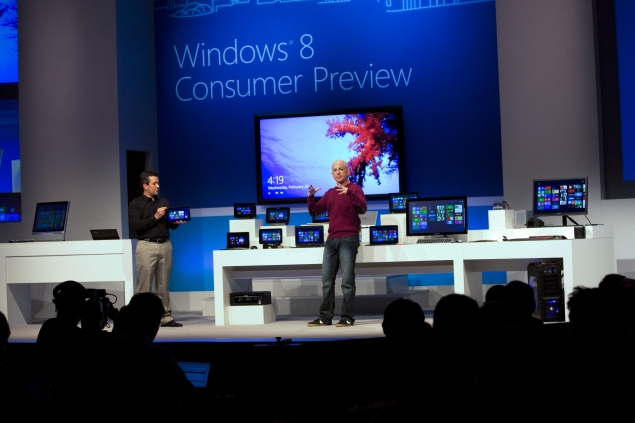
Microsoft believes the latest version of its Windows operating system is off to a great start, but it's going to take more than that to prove the revamped software will win over enough people to revive the slumping personal computer market.
About 40 million licenses to Windows 8 were sold in its first month on the market, according to figures that Microsoft released in conjunction with the company's annual shareholder meeting held near its Redmond, Wash., headquarters.
While that number may look impressive, it's difficult to know what it means without more insights into how many Windows 8 devices have been sold in stores, said technology industry analyst Patrick Moorhead of Moor Insights & Strategy. That's because PC manufacturers pay for most Windows 8 machines, leaving it unclear how many have been purchased by consumers, companies and government agencies.
Microsoft didn't provide further details beyond saying that Windows 8 is being embraced by a list of companies that include Johnson & Johnson, British Telecom and Bank of America Corp.
The initial reception to Windows 8 appears to be "good, but not great," Moorhead said. "Is this going to be enough to turn around the PC market? No."
Another analyst, Rick Sherlund of Nomura Securities, said he thinks it's going to take longer than he initially expected for Windows 8 to make a significant difference in a computing market that is moving away from desktop and laptop PCs and tilting toward smartphones and tablet computers.
Microsoft built Windows 8 to enable people to control their PCs by touching on the display screen, just like mobile devices. A similar operating system called Windows RT is running on a tablet called Surface that Microsoft created to compete against Apple Inc.'s popular iPad and similar devices designed by Google Inc. and Amazon.com Inc.
Sherlund, though, said other manufacturers aren't introducing Windows 8 devices that highlight the software's touch-control features as quickly as he expected. What's more, Nomura Securities projects sales of traditional PCs in the fourth quarter to decline by 7 percent from the same time last year. Another research firm, HIS iSuppli, already has predicted that this year will mark the first time annual sales of PCs will have fallen from the previous year since 2001.
In a research note issued Wednesday, Sherlund underscored his more sedate outlook by lowering his financial forecast for Microsoft. The revision trimmed his previous revenue estimate for Microsoft's fiscal year ending in June by 3 percent, or $2.3 billion.
Microsoft's stock price gained 28 cents Wednesday to close at $27.36, leaving them slightly below where they stood before Windows 8's Oct. 26 release.
Comments
For the latest tech news and reviews, follow Gadgets 360 on X, Facebook, WhatsApp, Threads and Google News. For the latest videos on gadgets and tech, subscribe to our YouTube channel. If you want to know everything about top influencers, follow our in-house Who'sThat360 on Instagram and YouTube.
Further reading:
Windows 8, PCs, Microsoft, Windows RT, Windows operating system, Microsoft Surface, Surface tablet
Related Stories


Advertisement

Follow Us

-
![[Sponsored] A Day in the Life of a Galaxy AI-Powered Professional](https://www.gadgets360.com/static/desktop/images/spacer.png)
03:18
[Sponsored] A Day in the Life of a Galaxy AI-Powered Professional -
02:43
Best Camera Phones Under 30,000 Rupees -
03:08
Top 5 TWS Earbuds Under Rs. 5000 in 2025!: Best Budget Wireless Earbuds -
21:40
Talking AI, Startups, Fake NEWS & More With Kirthiga Reddy -
02:56
Apple Launched New MacBook Air, iPad Air & Mac Studio - What's New?
Advertisement
Popular on Gadgets
- Samsung Galaxy Unpacked 2025
- ChatGPT
- Redmi Note 14 Pro+
- iPhone 16
- Apple Vision Pro
- Oneplus 12
- OnePlus Nord CE 3 Lite 5G
- iPhone 13
- Xiaomi 14 Pro
- Oppo Find N3
- Tecno Spark Go (2023)
- Realme V30
- Best Phones Under 25000
- Samsung Galaxy S24 Series
- Cryptocurrency
- iQoo 12
- Samsung Galaxy S24 Ultra
- Giottus
- Samsung Galaxy Z Flip 5
- Apple 'Scary Fast'
- Housefull 5
- GoPro Hero 12 Black Review
- Invincible Season 2
- JioGlass
- HD Ready TV
- Laptop Under 50000
- Smartwatch Under 10000
- Latest Mobile Phones
- Compare Phones
Latest Gadgets
- Samsung Galaxy F16 5G
- iQOO Neo 10R
- Tecno Camon 40 Premier 5G
- Infinix Note 50 Pro+
- Infinix Note 50 Pro
- Infinix Note 50
- Vivo T4x 5G
- Nubia Neo 3 GT 5G
- Asus Zenbook A14 (UX3407RA)
- Tecno Megabook S14
- Lenovo Tab K9
- Apple iPad (2025) Wi-Fi + Cellular
- boAt Ultima Prime
- boAt Ultima Ember
- Haier M95E
- Sony 65 Inches Ultra HD (4K) LED Smart TV (KD-65X74L)
- Sony PlayStation 5 Pro
- Sony PlayStation 5 Slim Digital Edition
- Blue Star 1.5 Ton 3 Star Inverter Split AC (IC318DNUHC)
- Blue Star 1.5 Ton 3 Star Inverter Split AC (IA318VKU)

- About Us
- Sitemaps
- Feedback
- Archives
- Contact Us
- RSS
- Advertise
- Career
- Privacy Policy
- Ethics
- Editorial Policy
- Terms & Conditions
- Complaint Redressal
Download Our Apps
Available in Hindi
© Copyright Red Pixels Ventures Limited 2025. All rights reserved.


