




-
 Intel, TSMC Tentatively Agree to Form Chipmaking Joint Venture: Report4 April 2025
 -
Microsoft Is Expanding Snapdragon-Exclusive AI Features to Intel, AMD-Powered Copilot+ PCs1 April 2025
-
Intel CEO Lip-Bu Tan Says Company Will Spin Off Non-Core Units1 April 2025
-
Intel Appoints Chip Industry Veteran Lip-Bu Tan as CEO13 March 2025
-
TSMC Said to Have Pitched Intel Foundry JV to Nvidia, AMD and Broadcom12 March 2025
- Home
- Laptops
- Laptops News
- PC titans eyeing tablet makers to regain customers
PC titans eyeing tablet makers to regain customers
By Reuters | Updated: 17 January 2013 13:33 IST
Advertisement
Personal computer makers, trying to beat back a tablet mania that's eating into their sales, are making what may be a last-ditch attempt to sway customers by mimicking the competition.
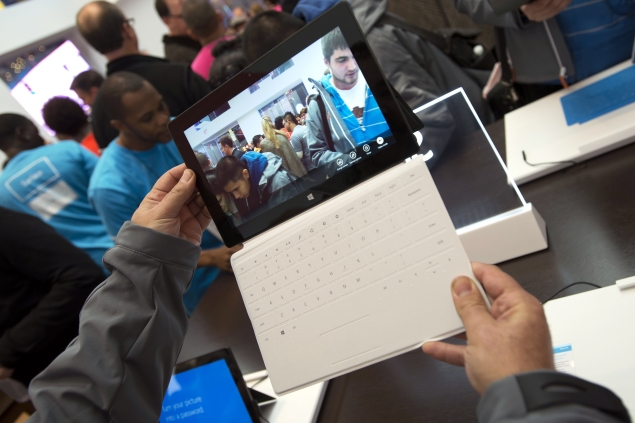
Many of the laptops to be unveiled around the world in coming months will be hybrids or "convertibles" - morphing easily between portable tablets and full-powered laptops with a keyboard, industry analysts say.
The wave of hybrids comes as Intel Corp and Microsoft Corp, long the twin leaders of the PC industry, prepare to report results this week and next. Wall Street is predicting flat to sluggish quarterly revenue growth for both, underscoring the plight of an industry that has struggled to innovate.
In 2013, some are hoping that will change.
With the release of Microsoft's touch-centric, re-imagined Windows 8 platform in October and more power-efficient chips from Intel, PC makers are trying to spark growth by focusing on creating slim laptops with touchscreens that convert to tablets and vice versa.
Microsoft, expanding beyond its traditional business of selling software, is expected this month to roll out a "Surface Pro" tablet compatible with legacy PC software developed over decades.
That's a major selling point for corporate customers like German business software maker SAP, which plans to buy Surface Pros for employees that want it, said SAP Chief Information Officer Oliver Bussmann.
"The hybrid model is very compelling for a lot of users," Bussmann told Reuters last week. "The iPad is not replacing the laptop. It's hard to create content. That's the niche that Microsoft is going after. The Surface can fill that gap."
Apple's iPad began chipping away at demand for laptops in 2010, an assault that accelerated with the launch of Amazon.com Inc's Kindle Fire and other Google Android devices like Samsung Electronics' Note.
With sales of PCs falling last year for the first time since 2001, this year may usher in a renaissance in design and innovation from manufacturers who previously focused on reducing costs instead of adding new features to entice consumers.
"People used to be able to just show up at the party and do well just because the market was going up," Lisa Su, a senior vice president at Advanced Micro Devices, which competes against Intel. "It's harder now. You can't just show up at the party. You have to innovate and have something special."
At last week's Consumer Electronics Show in Las Vegas, devices on display from Intel and others underscored the PC industry's plan to bet more on convertible laptops.
Lenovo's North America President Gerry Smith told Reuters last week that over the holidays he sold out of the company's "Yoga", a laptop with a screen that flips back behind its keyboard, and the "ThinkPad Twist", another lightweight laptop with a swiveling screen.
Intel itself showed off a hybrid prototype laptop dubbed "North Cape", housed in a thin tablet screen that attaches magnetically to a low-profile keyboard. And Asus showed a hefty 18-inch, all-in-one Windows 8 PC that converts to a tablet running Google's Android operating system.
Lenovo and Asus, which have both won positive reviews for their devices in recent months, increased their PC shipments by 14 percent and 17 percent respectively last year, according to Gartner.
"The number of unique systems that our partners have developed for Windows has almost doubled since launch. That gives an indication of how much innovation is going into the PC market," Tami Reller, chief financial officer of Microsoft's Windows unit, told Reuters.
Finger pointing
To be sure, hybrids with detachable or twistable screens do not yet account for a significant proportion of global PC sales, and consumers still need to be sold on their benefits.
Previous attempts by PC makers to reinvigorate the market have had limited success. Pushed by Intel, manufacturers launched a series of slimmed down laptops early last year with features popular on tablets, like solid-state memory.
They were too expensive, often at more than $1,000 apiece, and failed to arrest the PC decline.
Microsoft's Windows 8 launch in October brought touchscreen features but failed to spark a resurgence in PC sales many manufacturers had hoped for. A round of finger-pointing ensued, with PC and chip executives blaming a shortage of touchscreen components and others saying it was the manufacturers that sharply underestimated consumer demand for touch devices.
Regardless, the entire PC ecosystem is onboard for 2013. Almost half of the Windows laptops rolled out this year may have touch screens. Of those, most will be in convertible form, according to IDC analyst David Daoud.
Further blurring the distinction between kinds of devices, about a quarter of upcoming Windows 8 gadgets will be tablets that can easily act as laptops with the help of keyboard accessories, he added.
But buyers may have to wait until the second half of the year to see many of them.
"The most likely scenario today is for the industry to have these products ready for the back-to-school season," Daoud said.
© Thomson Reuters 2012
Comments
For the latest tech news and reviews, follow Gadgets 360 on X, Facebook, WhatsApp, Threads and Google News. For the latest videos on gadgets and tech, subscribe to our YouTube channel. If you want to know everything about top influencers, follow our in-house Who'sThat360 on Instagram and YouTube.
Further reading:
Intel, Lenovo, Microsoft, Microsoft Surface tablet, Microsoft Windows 8, PCs, Surface Pro tablet, Windows 8, hybrid laptops, tablets
Related Stories
Advertisement

Follow Us

-

01:18
Gadgets 360 With Technical Guruji: Did You Know This About the Firefox Logo? -
02:23
Gadgets 360 With Technical Guruji: Hands on With the Samsung Galaxy Book5 Pro 360 -
02:23
Gadgets 360 With Technical Guruji: A Quick Look at the Google Pixel 9a -
01:31
Gadgets 360 With Technical Guruji: Scanning Documents Without Third-Party Apps -
02:40
Gadgets 360 With Technical Guruji: News of the Week [March 29, 2025]
-
8000 रुपये सस्ता मिल रहा Realme 13 Pro, जानें क्या है पूरी डील
-
Poco C71 Rs 6,499 रुपये में 120Hz डिस्प्ले, 6GB रैम के साथ लॉन्च, जानें
-
Honor Play 60, Play 60m लॉन्च, 6000mAh बैटरी के साथ ऐसे हैं फीचर्स
-
Poco C71 vs LAVA Bold 5G: कौन सा किफायती फोन है ज्यादा बेहतर
-
Ultraviolette का Tesseract स्कूटर हुआ महंगा, जानें नया प्राइस
Advertisement
Popular on Gadgets
- Samsung Galaxy Unpacked 2025
- ChatGPT
- Redmi Note 14 Pro+
- iPhone 16
- Apple Vision Pro
- Oneplus 12
- OnePlus Nord CE 3 Lite 5G
- iPhone 13
- Xiaomi 14 Pro
- Oppo Find N3
- Tecno Spark Go (2023)
- Realme V30
- Best Phones Under 25000
- Samsung Galaxy S24 Series
- Cryptocurrency
- iQoo 12
- Samsung Galaxy S24 Ultra
- Giottus
- Samsung Galaxy Z Flip 5
- Apple 'Scary Fast'
- Housefull 5
- GoPro Hero 12 Black Review
- Invincible Season 2
- JioGlass
- HD Ready TV
- Laptop Under 50000
- Smartwatch Under 10000
- Latest Mobile Phones
- Compare Phones
Latest Gadgets
- Honor 400 Lite
- Honor Play 60m
- Honor Play 60
- Poco C71
- Lava Bold 5G
- Huawei Pura X
- Motorola Edge 60 Fusion
- Redmi A5
- Acer TravelLite (2025)
- Asus Zenbook 14 (2025)
- Samsung Galaxy Tab S10 FE+
- Samsung Galaxy Tab S10 FE
- Garmin Instinct 3
- Garmin Instinct E
- Haier M80F Mini LED 4K
- Haier M95E
- Nintendo Switch 2
- Sony PlayStation 5 Pro
- LG 1.5 Ton 5 Star Inverter Window AC (UW-Q18WUZA)
- LG 1.5 Ton 3 Star Inverter Split AC (US-Q18JNXE)

- About Us
- Sitemaps
- Feedback
- Archives
- Contact Us
- RSS
- Advertise
- Career
- Privacy Policy
- Ethics
- Editorial Policy
- Terms & Conditions
- Complaint Redressal
Download Our Apps
Available in Hindi
© Copyright Red Pixels Ventures Limited 2025. All rights reserved.