





-
 Apple’s Siri Chief Said to Acknowledge AI Delays, Promise Fixes15 March 2025
 -
Apple's AirPods to Get Live Conversation Translation Feature With iOS 19 Update: Report15 March 2025
-
UK, US Said to Hold Talks in Bid to Resolve Apple Encryption Feud15 March 2025
-
iPhone 17 Air's Total Thickness With Camera Bump Suggested in New Leak13 March 2025
-
Apple’s Smart Home Hub Tipped to Adopt iOS 19-Style UI; Launch Delayed to Post WWDC 202513 March 2025
- Home
- Laptops
- Laptops News
- Apple to return some Mac manufacturing to US in 2013
Apple to return some Mac manufacturing to US in 2013
By Associated Press | Updated: 7 December 2012 09:46 IST
Advertisement
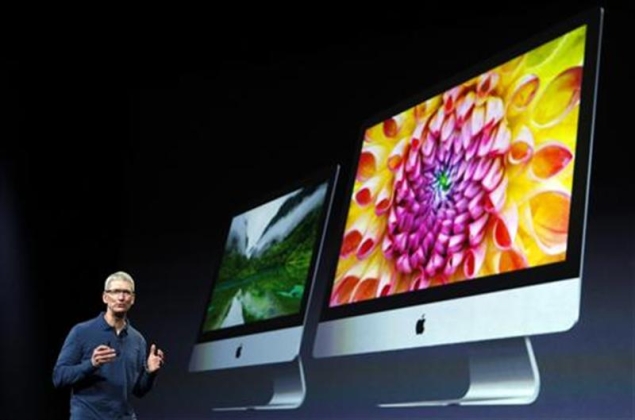
Apple CEO Tim Cook says the company will move production of one of its existing lines of Mac computers from China to the United States next year.
Industry watchers said the announcement is both a cunning public-relations move and a harbinger of more manufacturing jobs moving back to the U.S. as wages rise in China.
Cook made the comments in part of an interview taped for NBC's "Rock Center," but aired Thursday morning on "Today" and posted on the network's website.
In a separate interview with Bloomberg Businessweek, he said that the company will spend $100 million in 2013 to move production of the line to the U.S. from China.
"This doesn't mean that Apple will do it ourselves, but we'll be working with people and we'll be investing our money," Cook told Bloomberg.
That suggests the company could be helping one of its Taiwanese manufacturing partners, which run factories in China, to set up production lines in the U.S. devoted to Apple products. Research firm IHS iSuppli noted that both Foxconn Technology Group, which assembles iPhones, and Quanta Computer Inc., which does the same for MacBooks, already have small operations in the U.S.
Apple representatives had no comment Thursday beyond Cook's remarks.
Like most consumer electronics companies, Apple forges agreements with contract manufacturers to assemble its products overseas. However, the assembly accounts for a fraction of the cost of making a PC or smartphone. Most of the cost lies in buying chips, and many of those are made in the U.S., Cook noted in his interview with NBC.
The company and Foxconn have faced significant criticism this year over working conditions at the Chinese facilities where Apple products are assembled. The attention prompted Foxconn to raise salaries.
Cook didn't say which line of computers would be produced in the U.S. or where in the country they would be made. But he told Bloomberg that the production would include more than just final assembly. That suggests that machining of cases and printing of circuit boards could take place in the U.S.
The simplest Macs to assemble are the Mac Pro and Mac Mini desktop computers. Since they lack the built-in screens of the MacBooks and iMacs, they would likely be easier to separate from the Asian display supply chain.
Analyst Jeffrey Wu at IHS iSuppli said it's not uncommon for PC makers to build their bulkier products close to their customers to cut down on delivery times and shipping costs.
Regardless, the U.S. manufacturing line is expected to represent just a tiny piece of Apple's overall production, with sales of iPhones and iPads now dwarfing those of its computers.
Apple is latching on to a trend that could see many jobs move back to the U.S., said Hal Sirkin, a partner with The Boston Consulting Group. He noted that Lenovo Group, the Chinese company that's neck-and-neck with Hewlett-Packard Co. for the title of world's largest PC maker, announced in October that it will start making PCs and tablets in the U.S.
Chinese wages are raising 15 to 20 percent per year, Sirkin said. U.S. wages are rising much more slowly, and the country is a cheap place to hire compared to other developed countries like Germany, France and Japan, he said.
"Across a lot of industries, companies are rethinking their strategy of where the manufacturing takes place," Sirkin said.
Carl Howe, an analyst with Yankee Group, likened Apple's move to Henry Ford's famous 1914 decision to double his workers' pay, helping to build a middle class that could afford to buy cars. But Cook's goal is probably more limited: to buy goodwill from U.S. consumers, Howe said.
"Say it's State of the Union 2014. President Obama wants to talk about manufacturing. Who is he going to point to in the audience? Tim Cook, the guy who brought manufacturing back from China. And that scene is going replay over and over," Howe said. "And yeah, it may be only (public relations), but it's a lot of high-value PR."
Cook said in his interview with NBC that companies like Apple chose to produce their products in places like China, not because of the lower costs associated with it, but because the manufacturing skills required just aren't present in the U.S. anymore.
He added that the consumer electronics world has never really had a big production presence in the U.S. As a result, it's really more about starting production in the U.S. than bringing it back, he said.
But for nearly three decades Apple made its computers in the U.S. It started outsourcing production in the mid-90s, first by selling some plants to contract manufacturers, then by hiring manufacturers overseas. It assembled iMacs in Elk Grove, Calif., until 2004.
Some Macs already say they're "Assembled in USA." That's because Apple has for years performed final assembly of some units in the U.S. Those machines are usually the product of special orders placed at its online store. The last step of production may consist of mounting hard drives, memory chips and graphics cards into computer cases that are manufactured elsewhere. With Cook's announcement Thursday, the company is set to go much further in the amount of work done in the U.S.
The news comes a day after Apple posted its worst stock drop in four years, erasing $35 billion in market capitalization. Apple's stock rose $8.45, or 1.6 percent, to close at $547.24 Thursday.
Comments
For the latest tech news and reviews, follow Gadgets 360 on X, Facebook, WhatsApp, Threads and Google News. For the latest videos on gadgets and tech, subscribe to our YouTube channel. If you want to know everything about top influencers, follow our in-house Who'sThat360 on Instagram and YouTube.
Related Stories


Advertisement

Follow Us

-

01:08
Gadgets 360 With Technical Guruji: How to Eliminate Distractions on Websites -
02:45
Gadgets 360 With Technical Guruji: Lava Prowatch X -
01:13
Gadgets 360 With Technical Guruji: Did You Know Google Was Originally Called Backrub? -
03:55
Gadgets 360 With Technical Guruji: Samsung Galaxy A56 5G and Galaxy A36 5G -
16:43
Gadgets 360 With Technical Guruji: Jio Partners SpaceX, Xiaomi 15 Series and Samsung Galaxy A56
-
OnePlus 13T के डिजाइन का खुलासा, होगा सबसे सस्ता Snapdragon 8 Elite फोन!
-
OnePlus Pad 2 Pro टैबलेट में मिलेगी 16GB रैम! लॉन्च से पहले खुलासा
-
Oppo A5 Pro 4G फोन आया 8GB रैम, 5800mAh बैटरी, 45W चार्जिंग के साथ, जानें
-
Nothing Phone (3a) पर मिल रहा डिस्काउंट, Flipkart पर गिरी कीमत
-
6000mAh बैटरी के साथ Realme 14 5G का लॉन्च कंफर्म, जानें खास फीचर्स
Advertisement
Popular on Gadgets
- Samsung Galaxy Unpacked 2025
- ChatGPT
- Redmi Note 14 Pro+
- iPhone 16
- Apple Vision Pro
- Oneplus 12
- OnePlus Nord CE 3 Lite 5G
- iPhone 13
- Xiaomi 14 Pro
- Oppo Find N3
- Tecno Spark Go (2023)
- Realme V30
- Best Phones Under 25000
- Samsung Galaxy S24 Series
- Cryptocurrency
- iQoo 12
- Samsung Galaxy S24 Ultra
- Giottus
- Samsung Galaxy Z Flip 5
- Apple 'Scary Fast'
- Housefull 5
- GoPro Hero 12 Black Review
- Invincible Season 2
- JioGlass
- HD Ready TV
- Laptop Under 50000
- Smartwatch Under 10000
- Latest Mobile Phones
- Compare Phones
Latest Gadgets
- Redmi Note 14s
- Samsung Galaxy F16 5G
- iQOO Neo 10R
- Tecno Camon 40 Premier 5G
- Infinix Note 50 Pro+
- Infinix Note 50 Pro
- Infinix Note 50
- Vivo T4x 5G
- Asus Zenbook A14 (UX3407RA)
- Tecno Megabook S14
- Lenovo Tab K9
- Apple iPad (2025) Wi-Fi + Cellular
- boAt Ultima Prime
- boAt Ultima Ember
- Haier M95E
- Sony 65 Inches Ultra HD (4K) LED Smart TV (KD-65X74L)
- Sony PlayStation 5 Pro
- Sony PlayStation 5 Slim Digital Edition
- Blue Star 1.5 Ton 3 Star Inverter Split AC (IC318DNUHC)
- Blue Star 1.5 Ton 3 Star Inverter Split AC (IA318VKU)

- About Us
- Sitemaps
- Feedback
- Archives
- Contact Us
- RSS
- Advertise
- Career
- Privacy Policy
- Ethics
- Editorial Policy
- Terms & Conditions
- Complaint Redressal
Download Our Apps
Available in Hindi
© Copyright Red Pixels Ventures Limited 2025. All rights reserved.


