-
 Jio May Soon Receive Regulatory Approval for Launch of Satellite Internet Services in India: Report3 January 2024
 -
Poor Quality Results for Online Searches Made People Believe Possible Misinformation: Study25 December 2023
-
Government to Allot Satellite Internet Spectrum Without Auction in Win for Elon Musk’s Starlink19 December 2023
-
Government Planning New Regulations for Hosting Deepfakes: IT Minister23 November 2023
-
Starlink Set to Gain GMPCS Licence to Offer Satellite Communication Services in India: Report8 November 2023

- Home
- Internet
- Internet News
- Kim Dotcom launches new file sharing site, gets half a million users in 14 hours
Kim Dotcom launches new file-sharing site, gets half a million users in 14 hours
By Associated Press | Updated: 21 January 2013 14:09 IST
Advertisement
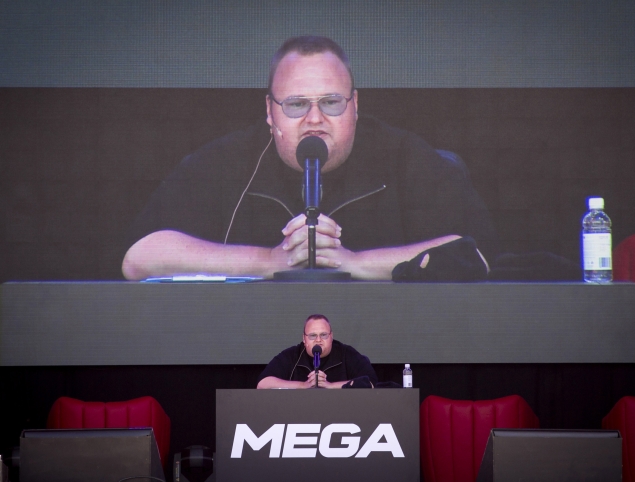
Indicted Megaupload founder Kim Dotcom launched a new file-sharing website that promises users greater privacy and defies the U.S. prosecutors who accuse him of facilitating massive online piracy.
The colorful entrepreneur unveiled the "Mega" site ahead of a lavish gala and news conference at his New Zealand mansion on Sunday night, the anniversary of his arrest on racketeering charges related to his now-shuttered Megaupload file-sharing site. The site Dotcom started in 2005 was one of the most popular sites on the Web until U.S. prosecutors shut it down and accused him and several company officials of facilitating millions of illegal downloads.
In Dotcom's typical grandiose style, the launch party featured a tongue-in-cheek re-enactment of the dramatic raid on his home a year earlier, when New Zealand police swooped down in helicopters onto the mansion grounds and nabbed him in a safe room where he was hiding.
"Mega is going to be huge, and nothing will stop Mega - whoo!" a gleeful Dotcom bellowed from a giant stage set up in his yard, seconds before a helicopter roared overhead and faux police agents rappelled down the side of his mansion. Dotcom eventually ordered everyone to "stop this madness!" before breaking out into a dance alongside miniskirt-clad "guards" as music boomed.
Bravado aside, interest in the site was certainly high. Dotcom said half a million users registered for Mega in its first 14 hours.
U.S. authorities are trying to extradite the German-born Internet tycoon from New Zealand, where he is free on bail. Prosecutors say Dotcom made tens of millions of dollars while filmmakers and songwriters lost around $500 million in copyright revenue.
U.S. prosecutors declined to comment on the new site, referring only to a court document that cites several promises Dotcom made while seeking bail that he would not - and could not - start a Megaupload-style business until the criminal case was resolved.
"I can assure the Court that I have no intention and there is no risk of my reactivating the Megaupload.com website or establishing a similar Internet-based business during the period until the resolution of the extradition proceedings," Dotcom said in a Feb. 15, 2012, affidavit.
Dotcom argues that he can't be held responsible for copyright infringement committed by others and insists Megaupload complied with copyrights by removing links to pirated material when asked.
"Our company and assets were taken away from us without a hearing," Dotcom said. "The privacy of our users was intruded on, communications were taken offline and free speech was attacked. Let me be clear to those who use copyright law as a weapon to drown innovation and stifle competition: You will be left on the side of the road of history."
Mega, like Megaupload, allows users to store and share large files. It offers 50 gigabytes of free storage, much more than similar sites such as Dropbox and Google Drive, and features a drag-and-drop upload tool.
The key difference is an encryption and decryption feature for data transfers that Dotcom says will protect him from the legal drama that has entangled Megaupload and threatened to put him behind bars.
The decryption keys for uploaded files are held by the users, not Mega, which means the company can't see what's in the files being shared. Dotcom argues that Mega - which bills itself as "the privacy company" - therefore can't be held liable for content it cannot see.
"What he's trying to do is give himself a second-string argument: 'Even if I was wrong before, this one's all right because how can I control something if I don't know that it's there?'" said Sydney attorney Charles Alexander, who specializes in intellectual property law. "I can understand the argument; whether it would be successful or not is another matter."
To Dotcom, the concept is very simple.
"If someone sends something illegal in an envelope through your postal service," he says, "you don't shut down the post office."
The Motion Picture Association of America, which filed complaints about alleged copyright infringement by Megaupload, was not impressed.
"We are still reviewing how this new project will operate, but we do know that Kim Dotcom has built his career and his fortune on stealing creative works," the MPAA said in a statement. "We'll reserve final judgment until we have a chance to take a closer look, but given Kim Dotcom's history of damaging the consumer experience by pushing stolen, illegitimate content into the marketplace, count us as skeptical."
Still, as much as Dotcom's new venture might enrage prosecutors and entertainment executives, it shouldn't have any impact on the Megaupload case.
"All it might do is annoy them enough to say, 'We're going to redouble our efforts in prosecuting them'," said Alexander, the attorney. "But I don't think it makes any practical difference to the outcome."
Dotcom denied the new site was designed to provoke authorities, but got in plenty of digs at their expense, saying that their campaign to shutter Megaupload simply forced him to create a new and improved site.
"Sometimes good things come out of terrible events," Dotcom said. "For example, if it wasn't for a giant comet hitting earth, we would still be surrounded by angry dinosaurs hungry, too. If it wasn't for that iceberg, we wouldn't have a great Titanic movie which makes me cry every time I see it. And if it wasn't for the raid, we wouldn't have Mega."
Comments
For the latest tech news and reviews, follow Gadgets 360 on X, Facebook, WhatsApp, Threads and Google News. For the latest videos on gadgets and tech, subscribe to our YouTube channel. If you want to know everything about top influencers, follow our in-house Who'sThat360 on Instagram and YouTube.
Further reading:
Internet, Kim Dotcom, Megaupload, Mega, File sharing, New Zealand, mega.co.nz, online piracy
Related Stories





Advertisement
Follow Us




-

03:19
Gadgets 360 With Technical Guruji: Something About the Nothing Ear, Ear (a) -
19:21
Gadgets 360 With Technical Guruji: Samsung's New AI Smart TVs, Nothing Ear -
05:23
Gadgets 360 With Technical Guruji: Samsung's New AI Smart TVs -
01:17
Gadgets 360 With Technical Guruji: Tech Tip [April 20, 2024] -
02:05
Gadgets 360 With Technical Guruji: Ask TG [April 20, 2024]
Advertisement
Popular on Gadgets
- AI
- iPhone 16 Leaks
- Apple Vision Pro
- Oneplus 12
- iPhone 14
- Apple iPhone 15
- OnePlus Nord CE 3 Lite 5G
- iPhone 13
- Xiaomi 14 Pro
- Oppo Find N3
- Tecno Spark Go (2023)
- Realme V30
- Best Phones Under 25000
- Samsung Galaxy S24 Series
- Cryptocurrency
- iQoo 12
- Samsung Galaxy S24 Ultra
- Giottus
- Samsung Galaxy Z Flip 5
- Apple 'Scary Fast'
- Housefull 5
- GoPro Hero 12 Black Review
- Invincible Season 2
- JioGlass
- HD Ready TV
- Laptop Under 50000
- Smartwatch Under 10000
- Latest Mobile Phones
- Compare Phones
Latest Gadgets
- HMD Pulse
- HMD Pulse+
- HMD Pulse Pro
- Realme Narzo 70x 5G
- Realme Narzo 70 5G
- Samsung Galaxy C55
- Blackview Hero 10
- Oppo K12
- Lenovo IdeaPad Pro 5i
- Asus ZenBook Duo 2024 (UX8406)
- Realme Pad 2 Wi-Fi
- Redmi Pad Pro
- boAt Storm Call 3
- Lava ProWatch Zn
- Samsung Samsung Neo QLED 8K Smart TV QN800D
- Samsung Neo QLED 4K Smart TV (QN90D)
- Sony PlayStation 5 Slim Digital Edition
- Sony PlayStation 5 Slim
- Lloyd 1.5 Ton 3 Star Inverter Split AC (GLS18I3FOSEW)
- Haier 1.5 Ton 3 Star Triple Inverter Split AC (HSU18K-PYSS3BN-INV)

- About Us
- Sitemaps
- Feedback
- Archives
- Contact Us
- RSS
- Advertise
- Career
- Privacy Policy
- Ethics
- Editorial Policy
- Terms & Conditions
- Complaint Redressal
Download Our Apps
Available in Hindi
© Copyright Red Pixels Ventures Limited 2024. All rights reserved.


