-
 Google Chrome Working on Feature Similar to Circle to Search on Android: Report10 May 2024
 -
WhatsApp Gets Darker Dark Mode, Redesigned Navigation, New Icons and More Design Changes10 May 2024
-
Android 15 Might Allow Third-Party Camera Apps to Offer Improved Video Stabilisation9 May 2024
-
Google's Android 14 May Security Update Rolls Out, Pixel 8 Gets Camera Bug Fix: How to Download9 May 2024
-
Microsoft Finds Major Security Flaw ‘Dirty Stream’ in Android Apps Totalling Billions of Downloads6 May 2024

New app could use your cellphone to forecast storms
By Press Trust of India | Updated: 11 February 2013 10:56 IST
Advertisement
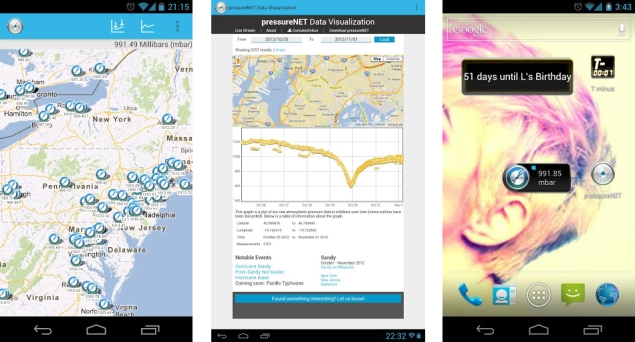
Researchers have developed a new app that lets users send pressure measurements to scientists which may help predict storms.
The app, called PressureNet, takes advantage of the latest sensor to show up in smart devices.
Some of the latest mobile devices now take atmospheric pressure measurements to determine elevation, in an effort to more precisely track location, the 'TechNewsDaily' reported.
At the same time, the pressure in an area can inform meteorologists about what's happening with the air masses in that location and help them forecast storms that will arrive over the next few hours.
Atmospheric scientists at the University of Washington in Seattle are trying to develop a way to use these device gathered measurements for short-term storm forecasts.
It will take some time for research before the scientists are able to test whether their method works. If it does, smartphone and tablet owners could help collect far more data than are now available from federally managed weather stations in the US.
"We could potentially have tens or hundreds of thousands of additional surface pressure observations, which could significantly improve short-term weather forecasts," Cliff Mass, who is leading the weather-predicting effort, said in a statement.
The UW team is now gathering about 4,000 data points an hour, the report said.
Previous versions of the app have been around since 2011, but its developers at the Canada-based Cumulonimbus just updated it in January so that users may share their data anonymously with Mass and colleagues.
"Thunderstorms are one of the areas of weakest skill for forecasting. I think thunderstorms in the middle part of the country could potentially be the biggest positive for this approach," he said.
Researchers hope to compare their smartphone- and tablet-aided forecasts to traditional predictions.
Comments
For the latest tech news and reviews, follow Gadgets 360 on X, Facebook, WhatsApp, Threads and Google News. For the latest videos on gadgets and tech, subscribe to our YouTube channel. If you want to know everything about top influencers, follow our in-house Who'sThat360 on Instagram and YouTube.
Related Stories




Advertisement
Follow Us




-

00:30
Sponsored | Galaxy A55 | A35 5G: Awesome Camera | Ft. #ShanayaKapoor & #RohanGurbaxani -
01:23
Google Wallet Launched in India: All You Need to Know -
02:17
Does a Mysterious Ninth Planet Exist Beyond Neptune? -
14:05
Vivo V30 Pro Review: Focussed on Photography -
15:01
Tech With TG: MAMI Film Festival and the Rise of Mobile Filmmaking
Popular on Gadgets
- AI
- iPhone 16 Leaks
- Apple Vision Pro
- Oneplus 12
- iPhone 14
- Apple iPhone 15
- OnePlus Nord CE 3 Lite 5G
- iPhone 13
- Xiaomi 14 Pro
- Oppo Find N3
- Tecno Spark Go (2023)
- Realme V30
- Best Phones Under 25000
- Samsung Galaxy S24 Series
- Cryptocurrency
- iQoo 12
- Samsung Galaxy S24 Ultra
- Giottus
- Samsung Galaxy Z Flip 5
- Apple 'Scary Fast'
- Housefull 5
- GoPro Hero 12 Black Review
- Invincible Season 2
- JioGlass
- HD Ready TV
- Laptop Under 50000
- Smartwatch Under 10000
- Latest Mobile Phones
- Compare Phones
Latest Gadgets
- Realme Realme GT Neo 6
- Nokia 3210 4G
- Vivo Y18e
- Vivo Y18
- Vivo Y38 5G
- Nokia 235 4G (2024)
- Nokia 225 4G (2024)
- Nokia 215 4G (2024)
- Dell Alienware X16 R2
- Lenovo IdeaPad Pro 5i
- Apple iPad Pro 13-inch (2024) Wi-Fi
- Apple iPad Pro 13-inch (2024) Wi-Fi + Cellular
- boAt Storm Call 3
- Lava ProWatch Zn
- Samsung Samsung Neo QLED 8K Smart TV QN800D
- Samsung Neo QLED 4K Smart TV (QN90D)
- Sony PlayStation 5 Slim Digital Edition
- Sony PlayStation 5 Slim
- LG 1.5 Ton 3 Star Inverter Window AC (TW-Q18WUXA)
- Godrej 1.1 Ton 3 Star Inverter Split AC (SIC 13DTC3 WWB)

- About Us
- Sitemaps
- Feedback
- Archives
- Contact Us
- RSS
- Advertise
- Career
- Privacy Policy
- Ethics
- Editorial Policy
- Terms & Conditions
- Complaint Redressal
Download Our Apps
Available in Hindi
© Copyright Red Pixels Ventures Limited 2024. All rights reserved.


